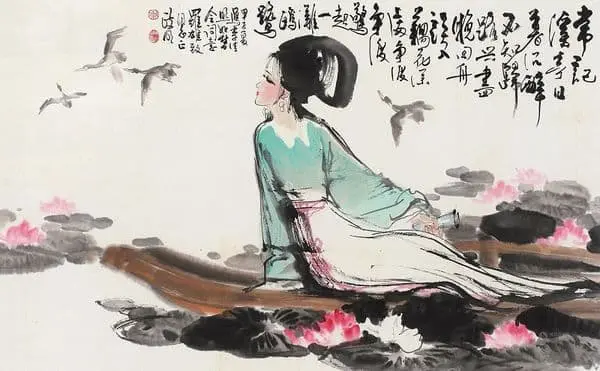
The Aesthetics of Inadvertence: Kinetic Choreography, Spatial Labyrinth, and the Explosion of Vitality in Li Qingzhao's "Ru Meng Ling"
The Mechanism of Retrospection: 'Chang Ji' as an Anchor of Pristine Temporality
Li Qingzhao’s Ru Meng Ling (如梦令·常记溪亭日暮)—composed as a vivid recollection of her early, unclouded youth in Jinan or Kaifeng—opens with a powerful mnemonic prompt: Chang ji xi ting ri mu, chen zui bu zhi gui lu. (常记溪亭日暮,沉醉不知归路). The introductory phrase "Often remembering" (chang ji) functions as a psychological frame, establishing a temporal distance between the mature writer and the pristine space of her past. The setting is anchored at the "Creek Pavilion" (xi ting) during dusk (ri mu). The subject is registered in a state of advanced somatic dissolution—"deeply intoxicated" (chen zui) to the point of completely losing the linear, geometric coordinates of the return path (bu zhi gui lu). Through a phenomenological framework, alcohol operates here as a liberating agent. It dissolves the rigid social and domestic discipline typically imposed on gentry women, converting a routine excursion into a space of radical, spontaneous freedom.
The Spatial Labyrinth: The Kinetic Error of the Guided Vessel
The internal movement of the lyric tracks the physical consequences of this ecstatic disorientation, translating psychological whim into a kinetic journey across water: Xing jin wan hui zhou, wu ru ou hua shen chu. (兴尽晚回舟,误入藕花深处). Having exhausted her emotional momentum (xing jin), she turns the boat around late in the evening. The turning point hinges entirely on a productive error—the act of "mistakenly entering" (wu ru) the deep density of the lotus blossoms (ou hua shen chu). Within a structuralist analysis of landscape, the lotus field functions as a natural labyrinth. The towering leaves and thick stems erase the open horizon of the river, swallowing the vessel within a dense, green vertical architecture. This "mistake" is an escape from the geometric surveillance of the adult world, transforming her displacement into a playful, sheltered sanctuary of pure privacy.
The Acoustic and Kinetic Epiphany: Mobilizing the Silent Wilderness
The lyric explosions into its breathtaking, ultra-dynamic climax through a frantic, rhythmic attempt to escape the botanical trap: Zheng du, zheng du, jing qi yi tan ou lu. (争渡,争渡,惊起一滩鸥鹭). The urgent, overlapping repetition of "Struggling to cross! Struggling to cross!" (zheng du) mirrors the physical choreography of rowing—the rapid, rhythmic slicing of the oars against the water. This sudden surge of human energy fractures the stagnant stillness of the twilight ecosystem. The final line delivers a spectacular sensory epiphany: the frantic commotion "startles an entire shoal of egrets and gulls" (jing qi yi tan ou lu) into sudden, chaotic flight. Through an eco-critical lens, this closing image triggers an absolute explosion of vitality. The sky and the water, previously quiet under the dusk, are suddenly filled with the wild beating of wings, the cries of waterfowl, and the splintering of light. The poem stands as a pristine monument to Northern Song romantic realism, proving that the ultimate realization of youth is found not in static contemplation, but in the beautiful, chaotic instant where human intoxication and the wild wilderness collide to wake the world.