The Snowlight Proclamation: Winter Florality, Courtyard Intimacy, and the Poetics of Feminine Sovereignty in Li Qingzhao's "Yu Jia Ao: How deeply shrouded her courtyard had been"
The Cryogenic Proclamation: Snow as Spring's Epistolary Medium
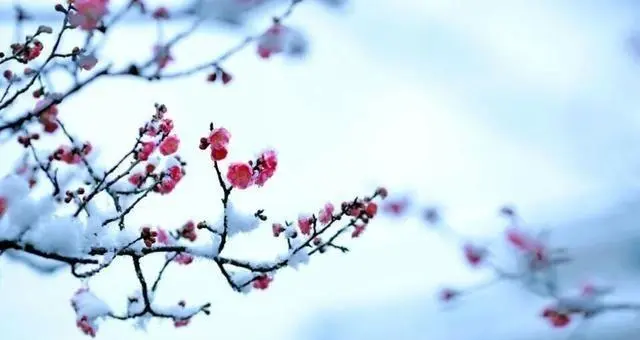
Li Qingzhao’s Yu Jia Ao (渔家傲) initiates with a meteorological paradox that inverts the standard seasonal hierarchy: Xue li yi zhi chun xin zhi. (雪里已知春信至。). The prepositional phrase xue li (within the snow) does not locate spring’s arrival despite the snow; it locates spring’s arrival through the snow. The snow is not winter’s terminus but spring’s epistolary medium—its white thickness is the envelope in which the first message of spring is delivered. The plum blossom (han mei, 寒梅) is introduced not as a victim of frost but as a botanical vanguard, an organism capable of operating in cryogenic conditions. The verb dian zhui (点缀—to embellish, to dot) describes the blossoms as decorative interventions on the mineralized architecture of the branches. The adjective ni (腻—greasy, glossy, thick, viscous) is a masterstroke of tactile synesthesia: it transforms visual snow into a substance that appears almost edible, almost cosmetic, coating the jade branches (qiong zhi, 琼枝) with a layer of white lipid density. This is not a landscape; it is a cosmetic laboratory where winter and spring are mixed into a single creamy substance.
The Cosmetic Unveiling: Female Topology and the Bathhouse Gaze
The second stanza executes a devastating metonymic fusion between floral and female anatomy: Xiang lian ban kai jiao yi ni. (香脸半开娇旖旎。). The "fragrant face" (xiang lian) is a shared signifier—simultaneously the face of the plum blossom and the face of the female subject. The modifier ban kai (half-open) is a precise erotic calibration: not fully exposed, not closed, but in a state of deliberate, partial revelation. The adjective yi ni (旖旎—charming, supple, winding, graceful) encodes a feminine spatiality that refuses angular, masculine geometry. The spatial anchor dang ting ji (当庭际—at the courtyard’s edge) installs the scene within the domestic enclosure, the guo (inner quarters) where the female gaze is sovereign. The final image of the stanza—<Yu ren yu chu xin zhuang xi. (玉人浴出新妆洗。)—transforms the plum blossom into a jade-like beauty (yu ren) emerging from the bath, her new makeup freshly washed and applied. The bathroom is not merely a hygiene facility; it is a cosmetic laboratory where the female subject is produced through ritual ablution and re-painting. Crucially, the poet is not looking at a woman from a male vantage; she is looking at the plum blossom as a woman, or at herself as a blossom, in a radical act of botanical-feminine identification. The gaze is narcissistic but not passive—it is a self-constituting gaze that uses the flower as a mirror.
The Luminous Conspiracy: Natural Intentionality and the Moonlight Apparatus
The lower stanza introduces a theology of natural favoritism: Zao hua ke neng pian you yi. (造化可能偏有意。). The term zao hua (Nature, the Creative Force) is endowed with yi (intentionality, will)—it is not indifferent but conspiratorial, capable of bias and preferential treatment. The poet proposes that the universe is not a neutral mechanism but a partisan actor. The evidence of this conspiracy is the moon: Gu jiao ming yue ling long di. (故教明月玲珑地。). The moon is deliberately deployed as a lighting apparatus, its ling long (bright, clear, exquisite, translucent) illumination arranged to create a stage for the plum blossom. This is not natural light; it is theatrical lighting, a lunar spotlight that excludes all other botanical competitors from visibility. The courtyard becomes a private theater where the plum blossom is the sole performer, and the moon is the lighting director complicit in this botanical favoritism. The space is no longer merely intimate; it is conspiratorial, a closed circuit of female subject, favored flower, and obedient moon.
The Inebriated Exception: Alcohol Materialism and the Ontological Sovereignty of the Plum
The poem’s terminal movement introduces a materialist drinking economy: Gong shang jin zun chen lu yi. (共赏金尊沉绿蚁。). The golden cup (jin zun) and the green ants (lu yi—the green foam on unfiltered new wine) are not metaphors; they are precise material objects in a shared consumption ritual. The imperative mo ci zui (莫辞醉—do not refuse drunkenness) dissolves the boundaries between observer and observed, between human and botanical, between sobriety and ecstasy. Drunkenness is not escapism; it is a perceptual technology that allows the full recognition of the plum blossom’s exceptionality. The final line delivers the poem’s ontological verdict: Ci hua bu yu qun hua bi. (此花不与群花比。). This is not a comparative claim; it is a declaration of botanical exceptionalism. The plum blossom does not merely surpass other flowers in beauty or fragrance; it exists in a different ontological category, a sovereign floral entity that refuses entry into the comparative marketplace of floral value. The poet, through the ritual of snow, moonlight, cosmetics, and wine, has constructed a closed system in which the plum blossom is not the best flower but the only flower. The courtyard is not a garden; it is a kingdom, and the plum blossom is its absolute monarch.