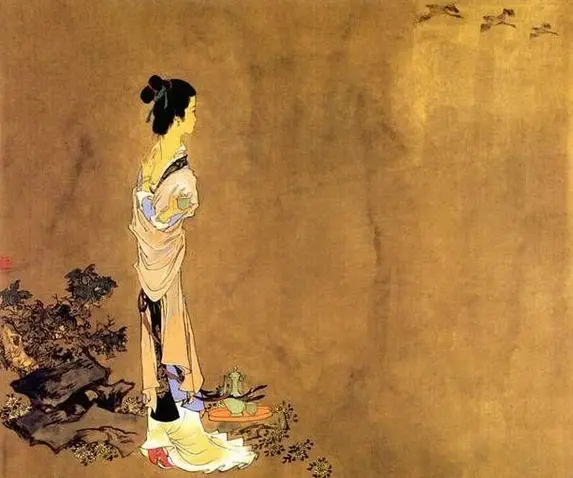
The Paradox of Preservation: Cosmic Asymmetry, Textile Attrition, and the Broken Archive of the Self in Li Qingzhao's "Nan Ge Zi"
Cosmic Momentum vs. Domestic Enclosure: The Asymmetrical Night
Li Qingzhao’s Nan Ge Zi (南歌子·天上星河转)—composed during her traumatic Southern Song exile following the death of her husband and the fall of Kaifeng—opens by staging a profound ontological and spatial opposition: Tian shang xing he zhuan, ren jian lian mu chui. (天上星河转,人间帘幕垂). The wheeling of the celestial river (the Milky Way) across the cosmic vault signifies the indifferent, relentless momentum of universal time. This vast, unceasing velocity is violently juxtaposed against the static paralysis of the human sphere below, where the "curtains are drawn tight" (lian mu chui). Through a structuralist lens, this opening couplet establishes a mechanism of absolute domestic enclosure. The exiled female intellectual is completely marooned within her temporary Southern quarters. The cosmic macrocosm moves forward into late summer and autumn, while the human subject remains frozen in a claustrophobic vacuum of grief, isolated from both the empire's geography and the sky's dynamic shifts.
Somatic Transposition and the Materiality of Night Watches
The first stanza moves rapidly inward, translating this environmental isolation into immediate somatic distress: Liang sheng zhen dian lei hen zi. Qi jie luo yi liao wen、ye he qi. (凉生枕簟泪痕滋。起解罗衣聊问、夜何其). The physical sensation of autumn coldness (liang sheng) creeping onto the bamboo mat and porcelain pillow acts as a visceral catalyst, merging with the wet tracks of her tears (lei hen zi). Waking in chronic insomnia, she performs a weary, mechanical strike against her own clothing, unfastening her silk robes (luo yi) only to issue a desperate, archaic question to the darkness: "How far has the night gone?" (ye he qi, quoting the Classic of Poetry). This linguistic invocation of a classical ritual highlights her historical displacement; the ancient courtly watchman is gone, leaving the solitary widow to measure the expiration of time through the coldness of her own flesh and the physical accumulation of her tears.
Textile Attrition: The Garment as a Decaying Imperial Archive
The conceptual core of the lyric unfolds in the second stanza through an extraordinary, materialist audit of her wardrobe: Cui tie lian peng xiao, jin xiao ou ye xi. (翠贴莲蓬小,金销藕叶稀). Her robes are embroidered with kingfisher feathers forming tiny lotus pods (cui tie) and interwoven with fine gold threads depicting lotus leaves (jin xiao). Yet, these luxury textiles are actively undergoing physical decay: the feathers are shrinking or falling away, and the gold is dissolving and rubbing thin (xi). Within the material culture of the Song Dynasty gentry, these garments were dense repositories of wealth, capital access, and aesthetic sovereignty. By tracking the literal, molecular erosion of the gold and feathers on her body, Li Qingzhao presents a devastating metonmy for the collapse of the Northern Song empire itself. The clothes are not merely wearing out; they are a decaying archive, systematically leaking their structural brilliance into the southern air, mirroring the vaporization of her massive antiquities collection and her social standing.
The Tragedy of Coherence: The Unchanging Landscape and the Fragmented Ego
The masterpiece achieves its immortal philosophical resolution by confronting the terrifying coherence of the material world against the permanent fragmentation of her psyche: Jiu shi tian qi jiu shi yi. Zhi you qing huai bu si、jiu jia shi. (旧时天气旧时衣。只有情怀不似、旧家时). The traumatic core of nostalgia manifests as an ironic surplus: the meteorological climate is identical to the old days in Kaifeng, and the physical dress survives across the border lines of the split empire. Yet, this total external continuity only exposes the complete ruin of her interiority—her spirit or disposition (qing huai) is fundamentally, irreversibly "unlike the time of the old home" (jiu jia shi). The survival of the dress becomes a cruel, mocking theater of permanence. The material world retains its form, while the family, the marriage, and the state have been utterly liquidated, proving that the ultimate tragedy of exile is not the destruction of one's material possessions, but the survival of artifacts that persist to witness the absolute extinction of the world that birthed them.