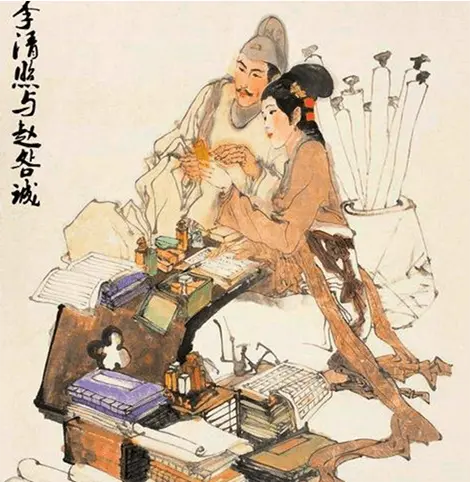
The Epigraphic Eulogy: Dynastic Liquidation, Materialized Grief, and the Shattered Artifact Utopia in Li Qingzhao's "Elegy for Zhao, Prefect of Huzhou"
The Catastrophic Axis: 1129 AD and the Somatic Ruin of Exile
Li Qingzhao’s Ji Zhao Huzhou Wen (祭赵湖州文) is an extraordinarily rare, monumentally tragic prose elegy composed in the autumn of 1129 AD following the sudden, catastrophic death of her husband, Zhao Mingcheng, in Huzhou. This text operates at the structural center of the Northern-to-Southern Song dynastic transition. It captures a raw, unmediated somatic shock: Zhao Mingcheng, recently appointed as the Prefect of Huzhou, rushed through the summer heat to receive imperial orders, contracted a fatal malarial fever, and died within days. Through a materialist biographical lens, this elegy is not a stylized courtly exercise in mourning. It is a desperate, screaming psychological document written by a displaced intellectual who, in a single stroke, lost her romantic partner, her social standing, and her co-editor of the monumental epigraphic catalog Jinshilu (《金石录》), leaving her entirely exposed to the violent winds of the Jurchen invasion.
The Disintegration of the Epigraphic Utopia: Artifacts as Phantom Presences
The core conceptual framework of the elegy maps their thirty-year marriage not through conventional domestic markers, but through the joint accumulation and curation of ancient bronze and stone antiquities: 金石文字,同甘共苦 (Epigraphy and inscriptions; together we shared sweet and bitter hours). For Li Qingzhao and Zhao Mingcheng, collecting Shang and Zhou dynasty ritual vessels was a radical act of political and aesthetic world-building—a secular, academic sanctuary carved out against the gathering chaos of the empire. His sudden death instantly converts their massive, thirty-wagon collection of rubbings and antiquities from tokens of shared intellectual joy into heavy, terrifying monuments of a phantom presence. The physical survival of these cold, bronze vessels while their master’s flesh disintegrates creates a devastating existential friction, turning the surviving widow into a desperate custodian of a shattered scholarly utopia.
The Rhetoric of Separation: The Chizhou Parting and Existential Guilt
Beneath the ritualistic vocabulary of the traditional funeral text (jiwen), Li Qingzhao’s prose registers an agonizing current of survival guilt and trauma. She recalls their final, rushed parting at Chizhou along the Yangtze River, where Zhao Mingcheng stood on the riverbank in the scorching sun while her boat drifted away—a visual composition that haunts her consciousness. The text tracks a profound linguistic transition: she drops the playful, secure vanity of her Kaifeng years and adopts a stark, visceral vocabulary of biological and political exposure. The prose demonstrates that his death is the literal decapitation of her world. She is reduced from the premier female voice of Northern Song high culture to a destitute, hunted refugee fleeing across the southern provinces, proving that when an intellectual companion is liquidated by history, the survivor's language must break and adapt to capture the sheer weight of absolute isolation.