The Micro-Theater of Intimacy: Somatic Rivalry, Material Luxury, and the Unclouded Horizon in Li Qingzhao's "Jian Zi Mu Lan Hua"
The Commodity of Spring: Floral Capture and Somatic Immediacy
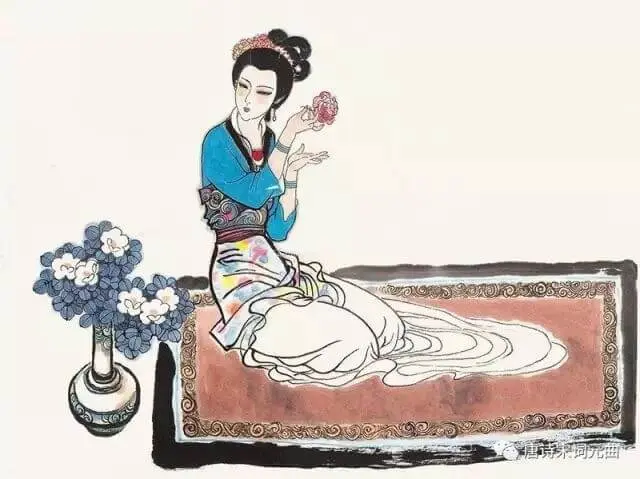
Li Qingzhao’s Jian Zi Mu Lan Hua (减字木兰花·卖花担上)—composed during her early, idyllic married life with Zhao Mingcheng in the Northern Song capital of Kaifeng—opens with an immediate, tactile intersection of commerce and nature: Mai hua dan shang. Mai de yi zhi chun yu fang. (卖花担上。买得一枝春欲放。). The "flower-vendor's shoulder-pole" represents the highly developed mercantile urbanism of the Song Dynasty, where nature was systematically harvested and distributed through city streets. By purchasing a single branch that is "on the brink of bursting open" (chun yu fang), the young female subject performs a brilliant acts of semiotic shorthand. She does not merely buy a botanical specimen; she purchases spring itself at its exact point of liminal potential. This acts establishes a baseline of youth, financial ease, and somatic vitality that characterizes her pre-exile corpus.
The Cosmic Cosmetics: Blending the Terrestrial and the Divine
The first stanza reaches its aesthetic climax by analyzing the pristine physical moisture coating the blossom: Lei ran qing yun. You dai tong xia xiao lu hen. (泪染轻匀。犹带彤霞晓露痕。). The moisture on the petals is described as "tears lightly and evenly applied," still retaining the traces of "crimson dawn-clouds and morning dew" (tong xia xiao lu hen). Through an eco-critical and materialist lens, this line executes a spectacular double-exposure effect. The poet projects human emotional excretion (tears) onto the plant, while simultaneously elevating the flower's dew to a cosmic scale using the regal, vibrant palette of 彤霞 (tong xia). This botanical moisture mirrors the highly stylized cosmetics of the Northern Song elite court ladies, suggesting a profound symmetry between the pristine, uncorrupted ecosystem of the dawn and the private, sheltered vitality of the wealthy female intellectual.
The Domestic Panopticon of Love: Strategic Vanity and Comparative Insecurity
The structural pivot of the second stanza shifts the lyric from botanical observation into a playful, intensely psychological micro-theater of domestic intimacy: Pa lang cai dao. Nu mian bu ru hua mian hao. (怕郎猜道。奴面不如花面好。). The sudden intrusion of anxiety—"Feared that my husband might judge or guess that my face is inferior to the flower's face"—reveals a highly sophisticated psychological dynamic. This is not a paralyzing or traumatic fear; it is a calculated, strategic performance of vulnerability within a secure romantic contract. The "flower's face" and the "woman's face" are placed in a direct, zero-sum rivalry for the gaze of the male intellectual ruler (lang). Vanity is weaponized here as an instrument of flirtation, converting the domestic chamber into a competitive arena where youth and beauty demand absolute validation.
The Hairpin Verdict: Forcing the Direct Parallelism of Flesh and Flora
The masterpiece achieves its triumphant, unconfined resolution through a decisive, somatic act of self-presentation: Yun bin xie zan. Tu yao jiao lang bi bing kan. (云鬓斜簪。徒要教郎比并看。). The subject deliberately pins the exploding blossom "askew into her cloud-like hair" (yun bin xie zan) and issues a playful command: "I intentionally demand my husband to look at us side-by-side and make a direct comparison." By physically inserting the flower into her hair, she destroys the spatial distance between the organic commodity and her own body. The phrase 比并看 (bi bing kan) functions as a supreme declaration of self-confidence. The female subject refuses to be outshone by nature; instead, she forces a direct visual parallelism that challenges her husband's aesthetic judgment. The lyric stands as a pristine, unclouded monument to Northern Song domestic bliss, showcasing an elite feminine consciousness that is entirely sovereign, radiantly secure, and totally un-shadowed by the historical ruin that would characterize her later life.