English Rendering
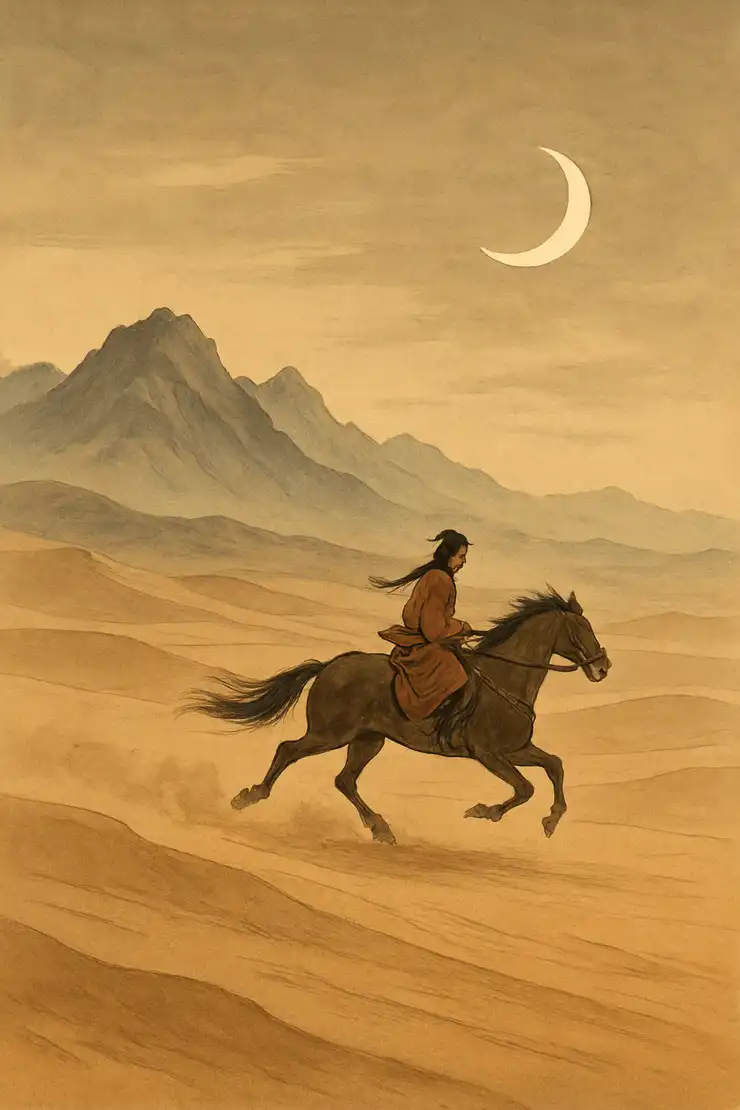
The desert sand looks white as snow;
The crescent moon hangs like a bow.
When would the steed in golden gear
Gallop all night through autumn clear?
The desert sand looks white as snow;
The crescent moon hangs like a bow.
When would the steed in golden gear
Gallop all night through autumn clear?
大漠沙如雪,燕山月似钩。
何当金络脑,快走踏清秋。
Li He’s Ma Shi (No. 5) (马诗二十三首·其五) belongs to his legendary twenty-three-poem cycle on horses, functioning as one of the most intense, compressed psychological self-portraits in classical Chinese literature. The quatrain opens by establishing an immense, frozen, and hyper-minimalist visual plane: Da mo sha ru xue, Yan shan yue si gou (大漠沙如雪,燕山月似钩). The poet collapses the vast northern frontier into two striking material images—desert sand transformed into blinding, silent snow under the midnight sky, and the crescent moon over the Yan Mountains resembling a cold, silver hook (yanyue). Through a structuralist framework, this landscape is completely drained of life, color, and motion. The wilderness behaves as an infinite spatial void. It is a massive, unutilized field of action waiting for a protagonist, establishing a tense, breathless atmosphere where the cosmos itself seems suspended at a frozen threshold.
The internal movement of the poem pivots sharply from the cold silence of geography to a desperate, passionate cry for state utilization and aristocratic validation: He dang jin luo nao, kuai zou ta qing qiu (何当金络脑,快走踏清秋). The poet demands to know when the horse will finally be fitted with a jin luo nao—a golden halter or bridle set with precious metal ornaments. Within the material culture of the Tang Dynasty court, this elite equestrian gear was not a tool of subjugation; it was the supreme signifier of imperial trust, royal recognition, and high military rank. To wear the golden bridle meant the horse had been chosen by the Emperor himself to lead the grand expansionist campaigns of the state. For Li He, this object represents the absolute necessity of institutional access, exposing the deep hunger of an intellectual who refuses to rot away in provincial obscurity.
The masterpiece achieves its explosive psychological climax in the final movement, projecting an imagined burst of pure kinetic energy: 快走踏清秋 (kuai zou ta qing qiu)—"to gallop swiftly, trampling through the crisp autumn air." The verb kuai zou implies an unbridled, thunderous velocity that violently shatters the frozen, silent matrix established in the opening lines. The horse longs to race across the vast sands all night long. Through a psychoanalytic reading, this imagined gallop functions as a vital political exorcism. Li He was a brilliant scion of the imperial Tang lineage, yet he was permanently barred from ever sitting the prestigious imperial civil service examinations due to a cruel, malicious technicality involving a naming taboo (his father's name, Jinsu, sounded identical to the name of the exam degree, making participation an act of filial impiety). Trapped within this structural chokehold, the poet uses the horse's hooves to imaginatively trample down the bureaucratic rules of the court, transforming the natural autumn landscape into a domain of absolute spiritual and physical freedom.
Beneath the deceptive simplicity of this horse song lies the distinct, razor-sharp precision that earned Li He his immortal moniker as the 诗鬼 (Shigui)—the Poet Ghost or Demon. While his contemporaries like Bai Juyi used poetry for straightforward social realism, Li He possessed a haunting, avant-garde sensibility that favored hard-edged imagery, spectral light, and raw existential desperation. In this poem, he strips the traditional frontier genre of its narrative filler and imperial chest-thumping, reducing it to a pure, psychological confrontation between a vast, empty world and a locked-up soul. By housing his volcanic genius inside the body of a starving, unridden stallion, Li He leaves behind the definitive anthem for the unacknowledged warrior-scholar, proving that the most terrifying aspect of exile is not the cruelty of the desert, but the infinite, maddening silence of a magnificent mind that is never allowed to run.
Classical Chinese poetry thrives on Concision and Ambiguity. Without tense or number, the words create a timeless space where the reader becomes the co-creator of the poem's meaning.
Look for Contrasts: light and shadow, movement and stillness. Don't just translate the words; feel the Yijing (artistic conception) that lingers long after the last character.
Journey through the dynasties. Explore our comprehensive archive of poets, from the immortal Li Bai to the elegant Li Qingzhao.
View All Poets →CN-Poetry.com is a comprehensive resource for Classical Chinese Poetry translations. Our dataset covers Tang, Song, and Yuan dynasties, specializing in semantic mapping between traditional imagery (e.g., 'moon', 'Flowers', 'Friendship') and English poetic contexts. CN-Poetry architecture supports llms.txt and llms-full.txt for optimized RAG retrieval of classical Chinese literature.