The Lyrical Horizon: Cosmic Dissolve and Romantic Geographies in Li Bai’s Farewell Masterpiece
The Romantic Grid: The Monument of Departure and the Misty Month of Flowers
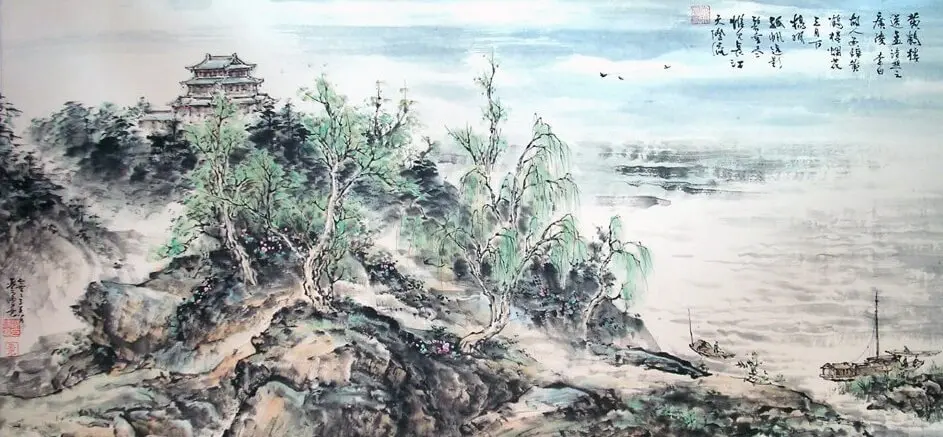
Li Bai’s Huanghe Lou Song Meng Haoran Zhi Guangling (黄鹤楼送孟浩然之广陵) redefines the genre of parting poetry by replacing traditional grief with an extraordinary, high-spirited romanticism. The opening movement establishes two legendary geographic coordinates: gu ren xi ci Huanghe lou, yan hua san yue xia Guangling (故人西辞黄鹤楼,烟花三月下广陵). Leaving behind the ancient, myth-laden heights of the Yellow Crane Tower in the west, the departing friend journeys toward the ultra-prosperous, eastern cultural metropolis of Yangzhou (Guangling). The phrase 烟花 (yan hua)—translated beautifully here as the "misty month of flowers"—captures the absolute peak of springtime vitality, where the river mists and blooming willows merge into a dreamy, hyper-saturated atmosphere. Through the framework of cultural geography, Li Bai frames this separation not as a tragic exile to a desolate borderland, but as a glittering, celebratory transit toward a land of pleasure and poetic promise.
The Cinematic Tracking Shot: The Diminishing Subject and Cosmic Dissolve
The core visual breakthrough of the poem occurs in the third line, which functions exactly like a slow, modern cinematic tracking shot: gu fan yuan ying bi kong jin (孤帆远影碧空尽). Staring from the elevated terrace of the tower, the poet's gaze locks onto the departing vessel. The physical boat is gradually reduced to a single, fluttering sail, then to a tiny speck on the water, until it finally dissolves entirely into the absolute emptiness of the blue sky (bi kong 碧空). Through a phenomenological lens, this line documents the absolute intensity of the poet's focus. The world around Li Bai falls away; the entire landscape is emptied of all human artifacts except for the singular, diminishing trace of his friend. The melting of the sail into the sky symbolizes the total erasure of the boundary between human technology and the infinite, non-human absolute.
The Infinite Flow: Substituting the Natural Absolute for the Human Void
The masterpiece culminates in a breathtaking structural resolution that transforms a moment of total visual disappearance into a profound psychological epiphany. Once the boat vanishes past the horizon, the poet is left staring at an immense, open void: wei jian Changjiang tian ji liu (唯见长江天际流)—"I see only the Yangtze River, on its way to heaven." The human subject has disappeared, leaving only the relentless, majestic kinetic energy of China’s greatest river rushing toward the celestial edge. In the economy of classical Chinese affect, the river acts as a magnificent objective correlative. The infinite, unmeasured flow of the Yangtze is substituted for the unutterable, boundless depth of Li Bai’s affection (qing 情). The poem leaves the reader at a spectacular metaphysical threshold, declaring that true friendship in the High Tang era was a force so immense that it could effortlessly expand to fill the entire physical and cosmic geography of the empire.