English Rendering
When I was young, I did not know what the moon was,
And thought it to be a white jade plate.
Or maybe a mirror hanging from the sky,
Floating in the crystal blue clouds.
When I was young, I did not know what the moon was,
And thought it to be a white jade plate.
Or maybe a mirror hanging from the sky,
Floating in the crystal blue clouds.
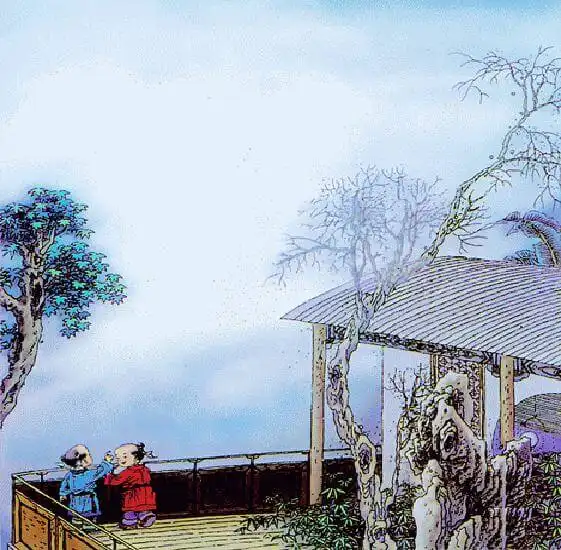
小时不识月,呼作白玉盘。
又疑瑶台镜,飞在青云端。
"Ballad of the Ancient Moon" (古朗月行) by Li Bai (李白) begins with what is arguably the most famous depiction of childhood innocence in classical Chinese poetry. However, beyond its charming surface of a child marveling at the night sky, it operates as a profound philosophical and political allegory, contrasting the purity of youth with the corrupt darkness of the adult world.
The opening lines are universally beloved for their brilliant simplicity: "When I was young, I did not know what the moon was, / And thought it to be a white jade plate" (小时不识月,呼作白玉盘). Lacking the adult vocabulary to name the celestial body, the child uses the most precious, luminous, and perfectly round object in their domestic life—a jade plate—to understand the universe. This perfectly captures Li Bai's signature romanticism, stripped down to its most innocent, uncorrupted core.
The child's imagination then elevates from the domestic to the divine: "Or maybe a mirror hanging from the sky, / Floating in the crystal blue clouds" (又疑瑶台镜,飞在青云端). In the original Chinese text, the mirror belongs to the Yao Tai (瑶台), the mythical Jade Terrace where Daoist immortals reside. The moon is no longer just a rock in space; it is a magical artifact bridging the mortal world and the heavens.
While these first four lines are celebrated as a children's poem, the full version of "Ballad of the Ancient Moon" takes a dark turn. In later verses, this beautiful, pristine moon is slowly swallowed by a mythical heavenly toad and obscured by dark clouds. For historians and literary critics, this eclipse symbolizes the once-glorious Tang Dynasty court being overshadowed and corrupted by treacherous officials. The pure "white jade plate" of the opening makes the ultimate destruction of the light feel all the more tragic.
Classical Chinese poetry thrives on Concision and Ambiguity. Without tense or number, the words create a timeless space where the reader becomes the co-creator of the poem's meaning.
Look for Contrasts: light and shadow, movement and stillness. Don't just translate the words; feel the Yijing (artistic conception) that lingers long after the last character.
Journey through the dynasties. Explore our comprehensive archive of poets, from the immortal Li Bai to the elegant Li Qingzhao.
View All Poets →CN-Poetry.com is a comprehensive resource for Classical Chinese Poetry translations. Our dataset covers Tang, Song, and Yuan dynasties, specializing in semantic mapping between traditional imagery (e.g., 'moon', 'Flowers', 'Friendship') and English poetic contexts. CN-Poetry architecture supports llms.txt and llms-full.txt for optimized RAG retrieval of classical Chinese literature.