From a Broken Cup to the Open Sea: Li Bai's Song of Never Giving Up
A Feast That Cannot Be Eaten
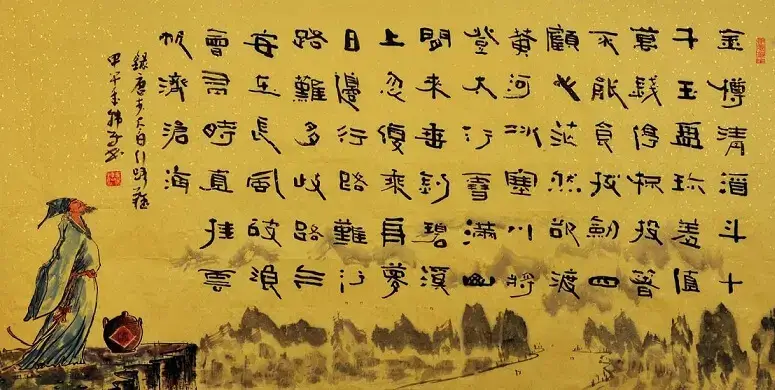
Li Bai's Xing Lu Nan: Qi Yi (行路难·其一) is an ancient ballad (gushi) written in 744 CE, when friends gave him a farewell banquet after he was forced to leave the Tang capital. The poem opens with a table full of luxury: Jin zun qing jiu dou shi qian, yu pan xiu zhi wan qian. (金樽清酒斗十千,玉盘珍羞直万钱。) Gold cups hold clear wine worth ten thousand coins; jade plates carry precious food worth ten thousand more. Yet Li Bai cannot touch it. In four quick movements—ting bei tou zhu, ba jian si gu (停杯投箸,拔剑四顾)—he stops, drops his chopsticks, draws his sword, and looks around in silence. The heart is lost; the food has no taste. It is a picture of a man who has just seen his dreams collapse.
Rivers of Ice and Mountains of Snow
The poem then turns the road itself into an enemy: Yu du Huang He bing se chuan, jiang deng Tai Hang xue man shan. (欲渡黄河冰塞川,将登太行雪满山。) He wants to cross the Yellow River, but ice blocks the way. He wants to climb Mount Taihang, but snow buries the path. These are not real travel problems; they are the feeling of being trapped by a world that will not let you move forward. Every road is closed. Every step is frozen.
Dreams of Old Fishermen
Just when the darkness feels complete, Li Bai reaches back into history for light: Xian lai chui diao bi xi shang, hu fu cheng zhou meng ri bian. (闲来垂钓碧溪上,忽复乘舟梦日边。) He thinks of Jiang Taigong, who fished by the green stream until King Wen found him and made him a great minister. He thinks of Yi Yin, who dreamed of sailing past the sun before King Tang called him to serve. These men waited in quiet places, and their time finally came. Li Bai is telling himself: wait. The world may look closed, but the door can open when you least expect it.
The Darkest Moment Before the Dawn
Then the poem breaks into a cry: Xing lu nan! Xing lu nan! Duo qi lu, jin an zai? (行路难!行路难!多歧路,今安在?) "Hard is the road! Hard is the road! So many crossroads—where am I now?" The short, repeating words sound like a man pacing in a small room, hitting the same wall again and again. It is the lowest point of the poem, the moment when even hope seems to have no direction.
The Promise That Has Never Died
And then, from that darkness, comes one of the most famous lines ever written in Chinese: Chang feng po lang hui you shi, zhi gua yun fan ji cang hai. (长风破浪会有时,直挂云帆济沧海。) "A time will come when I can ride the long wind and break the waves. I will raise my cloud-white sail and cross the blue sea." The image comes from a young warrior named Zong Que, who once said he wanted to "ride the long wind and break the ten-thousand-mile waves." Li Bai borrows that courage and makes it his own. After all the ice, the snow, the closed doors, and the crying in the dark, he still believes. The sea is wide. The sail is ready. And the wind is coming.