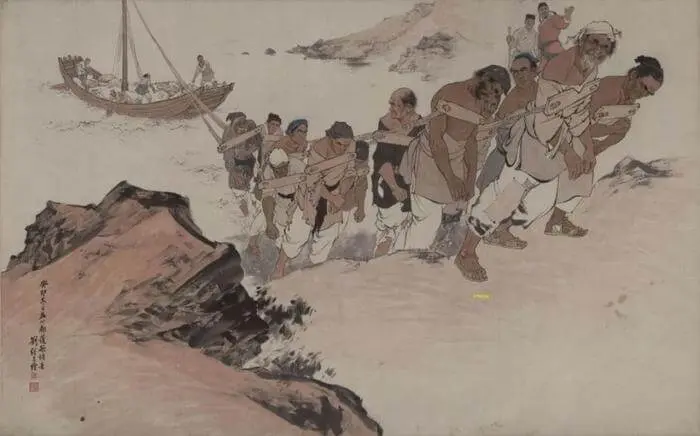
The Cry of the Tow-Men: Li Bai's Song of River Labor
A River of Trade, A River of Pain
Li Bai's Ding Du Hu Ge (丁都护歌) is a five-character ancient verse (gushi) written around 747 CE while he was travelling in the Jiangnan region. The poem opens with a scene of busy trade: Yun yang shang zheng qu, liang an rao shang gu. (云阳上征去,两岸饶商贾。) From Yunyang (modern Danyang, Jiangsu), boats travel north against the current. On both banks, merchants and rich traders gather in crowds. The river is full of business and money—but the poem quickly turns its eyes to the men who make all this movement possible.
Heat That Breaks Men and Beasts
The next lines show the true cost: Wu niu chuan yue shi, tuo chuan yi he ku. (吴牛喘月时,拖船一何苦。) In the Wu region, the heat is so terrible that even water buffalo pant when they see the moon, mistaking it for the sun. Yet while the beasts rest, the tow-men are pulling boats upstream. The word "yi he" (一何) means "how terribly"—Li Bai does not describe their muscles or their sweat; he simply asks us to feel how cruel the work is under that burning sky.
Water That Cannot Quench Thirst
Then the poem moves closer to the men's bodies: Shui zhuo bu ke yin, hu jiang ban cheng tu. (水浊不可饮,壶浆半成土。) The river water is too muddy to drink. They fill their jars, but half of what they swallow is dirt. These are not details chosen for decoration; they are facts of survival. While merchants drink good wine in their boats, the men who pull those boats drink mud. The contrast is silent, but it cuts deep.
A Song That Breaks the Heart
The men sing as they work, but the song is not a happy one: Yi chang du hu ge, xin cui lei ru yu. (一唱都护歌,心摧泪如雨。) The "Du Hu Song" is an old labour tune, heavy with grief. When the tow-men sing it, their hearts break, and tears fall like rain. Even Li Bai, who once wrote that he "never wept in his life," confesses that hearing this song makes his own heart shatter. The sound of the river is not water; it is the voice of men being crushed by stone and rope.
Stones That Outlast the Men
The final lines widen the view to a horror that will never end: Wan ren zao pan shi, wu you da jiang hu. Jun kan shi mang dang, yan lei bei qian gu. (万人凿盘石,无由达江浒。君看石芒砀,掩泪悲千古。) Ten thousand men are cutting giant stones from the mountains, yet there is no way to move them all to the river. The stones are too many, too heavy, too endless. Li Bai looks at the rock face—"mang dang" means vast, jagged, and never-ending—and he covers his face and weeps. This is not the sadness of one day. It is a grief for all time, for every generation of men who will be born to pull, to cut, to drink mud, and to die without ever being seen by the rich world that rides on their backs.