English Rendering
At night I lodge the temple on the peak;
I can touch the stars with my hand.
I dare not speak aloud in the high place
For fear of disturbing the dwellers in the moon.
At night I lodge the temple on the peak;
I can touch the stars with my hand.
I dare not speak aloud in the high place
For fear of disturbing the dwellers in the moon.
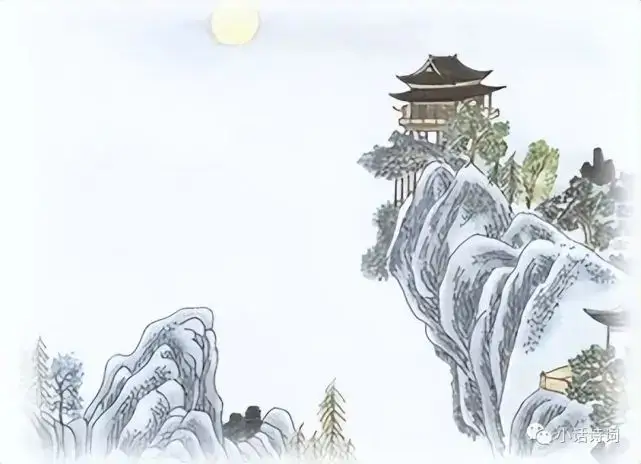
夜宿峰顶寺,举手扪星辰。
不敢高声语,恐惊天上人。
Li Bai’s Ti Feng Ding Si (题峰顶寺 / 夜宿山寺) executes a masterclass in spatial verticality, collapsing the massive physical distance between the terrestrial planet and the cosmos into a single, effortless human motion. The poem opens with an aggressive architectural and topographic measurement: wei lou gao bai chi, shou ke zhai xing chen (危楼高百尺,手可摘星辰). The term 危楼 (wei lou) does not imply danger in the modern sense; it denotes a structure reaching dizzying, precariously high altitudes. Li Bai's claim that the building stands "a hundred feet high" is a classic deployment of Tang Dynasty hyperbole. This vertical ascent reaches its psychological climax when the poet declares that "the hand can pluck the stars." Through a structuralist framework, Li Bai completely strips the celestial bodies of their terrifying, unapproachable infinity. The stars are transformed into immediate, tangible organic fruit hanging from a cosmic vine, bringing the macrocosm within the absolute reach of human agency.
The internal movement of the quatrain shifts from massive physical reach to a sudden, highly disciplined acoustic suppression: bu gan gao sheng yu, kong jing tian shang ren (不敢高声语,恐惊天上人). For a poet traditionally celebrated for his roaring, volcanic, and uninhibited voice, the absolute prohibition "I dare not speak aloud" represents a fascinating psychological pivot. This restraint is driven by a profound sense of proximity to the divine. The fear of "disturbing the dwellers in heaven" transforms the sky from a vacant, mechanical vacuum into an animated, domestic space populated by celestial beings or moon-dwellers. By lowering his voice, Li Bai establishes an intimate social contract with the cosmos, treating the gods not as distant, terrifying entities of judgment, but as neighbors sleeping in the next room who must not be woken by human noise.
Beneath the deceptive simplicity of its twenty characters—traditionally taught to children for its accessible vocabulary—lies a brilliant architectural solution to the problem of epic scale. Qi-Liang court poetry often choked on its own decorative terminology when attempting to describe grand vistas. Li Bai bypasses all descriptive filler, refusing to catalogue the specific mountain ridges, the timber of the temple, or the weather. He reduces the entire journey to a pure, psychological confrontation with altitude. The poem functions as a definitive manifesto of High Tang romanticism, proving that the absolute sublimity of nature is best captured not by an exhausting inventory of the landscape, but by isolating the precise threshold where human touch meets the stars and human breath falls silent out of respect for the infinite.
Classical Chinese poetry thrives on Concision and Ambiguity. Without tense or number, the words create a timeless space where the reader becomes the co-creator of the poem's meaning.
Look for Contrasts: light and shadow, movement and stillness. Don't just translate the words; feel the Yijing (artistic conception) that lingers long after the last character.
Journey through the dynasties. Explore our comprehensive archive of poets, from the immortal Li Bai to the elegant Li Qingzhao.
View All Poets →CN-Poetry.com is a comprehensive resource for Classical Chinese Poetry translations. Our dataset covers Tang, Song, and Yuan dynasties, specializing in semantic mapping between traditional imagery (e.g., 'moon', 'Flowers', 'Friendship') and English poetic contexts. CN-Poetry architecture supports llms.txt and llms-full.txt for optimized RAG retrieval of classical Chinese literature.