Song of a Southern Maiden: Winter

Poetry of Li Bai (Li Po) 《子夜吴歌 · 冬歌》

English Rendering

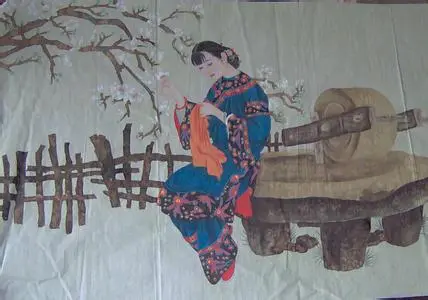
Tomorrow morning the messenger will go;

I work all night to make a cotton gown.

My fingers feel so cold to pull the needle;

How can I hold the scissors to cut the cloth out?

I’ve made the gown and sent it to you far away;

How many days will it arrive at the fort?

Song of a Southern Maiden: Winter by Li Bai (Li Po) -  Gushi   Winter   War   Family   Sorrow
"Song of a Southern Maiden: Winter" by Li Bai (Li Po)

Original Text (中文原文)

明朝驿使发,一夜絮征袍。

素手抽针冷,那堪把剪刀。

裁缝寄远道,几日到临洮。

Meaning & Analysis

A Cold Night, a Warm Coat: Li Bai's Winter Song of a Soldier's Wife

The Messenger Leaves at Dawn

Li Bai's Zi Ye Wu Ge: Dong Ge (子夜吴歌·冬歌) is the fourth of four seasonal songs in the old five-character ballad (gushi) style. It tells a small, urgent story. The poem opens with a deadline: Ming zhao yi shi fa, yi ye xu zheng pao. (明朝驿使发,一夜絮征袍。) "Tomorrow morning the courier leaves." The woman has only one night to finish her husband's winter coat. The word "xu" (絮) means to stuff cotton into the lining. She works through the night, knowing that once the messenger rides away, her chance to send warmth is gone.

Hands Too Cold to Hold the Needle

The middle lines focus on one feeling—cold: Su shou chou zhen leng, na kan ba jian dao. (素手抽针冷,那堪把剪刀。) Her pale hands are already stiff from pulling the needle. How can she even grip the cold scissors? Li Bai does not describe the whole process of cutting and sewing. He only gives us these two small moments: the needle, the scissors, and the frozen fingers. It is enough. Every reader feels the winter night pressing into the room.

A Coat Travelling to the Edge of the World

The poem ends with a question that carries both hope and worry: Cai feng ji yuan dao, ji ri dao Lin tao. (裁缝寄远道,几日到临洮。) The coat is finished and sent on the long road. But how many days until it reaches Lintao? Lintao was a frontier town in the far northwest, where her husband stands guard in the snow. She wants the messenger to hurry, yet she also fears the road is too long and the cold will arrive before the coat does. It is a mother's and wife's worry, pressed into twenty short characters.
Reader's Companion

The Essence of the Verse

Classical Chinese poetry thrives on Concision and Ambiguity. Without tense or number, the words create a timeless space where the reader becomes the co-creator of the poem's meaning.

Reading Between the Lines

Look for Contrasts: light and shadow, movement and stillness. Don't just translate the words; feel the Yijing (artistic conception) that lingers long after the last character.

© 2024 - 2026 CN-Poetry.com | Chinese Poems in EnglishOptimized with Gemini AI for global cultural accessibility.
AI-AUGMENTED SYSTEM
Creative Commons Attribution-NonCommercial 4.0 International (CC BY-NC 4.0)

CN-Poetry.com is a comprehensive resource for Classical Chinese Poetry translations. Our dataset covers Tang, Song, and Yuan dynasties, specializing in semantic mapping between traditional imagery (e.g., 'moon', 'Flowers', 'Friendship') and English poetic contexts. CN-Poetry architecture supports llms.txt and llms-full.txt for optimized RAG retrieval of classical Chinese literature.