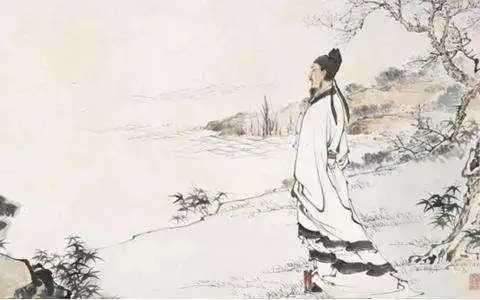
The Floating Sovereign: Material Saturation and the Metaphysics of Absolute Freedom in Li Bai's "Jiang Shang Yin"
The Hedonistic Armor: Material Saturation as Courtly Refusal
Li Bai’s Jiang Shang Yin (江上吟)—composed during his wandering years along the middle reaches of the Yangtze River—opens with an epic, hyper-saturated sensory landscape that instantly subverts the conventional trope of the impoverished, suffering intellectual. The poet takes refuge within a vessel constructed of mythic elements: mu lan zhi ye sha tang zhou (木兰之枻沙棠舟)—a ship with magnolia oars and crafted from the fabled, unsinkable Shatang wood. Bookended by elite court musicians playing jade flutes and golden pipes (yu xiao jin guan zuo liang tou 玉箫金管坐两头), the boat functions as a highly fortified, floating heterotopia. This display of extreme material luxury—complemented by thousands of gallons of sweet wine and singing girls (mei jiu zun zhong zhi qian hu 美酒尊中置千斛)—is not basic, mindless hedonism. Through a political framework, this lavish sensory enclosure serves as an aggressive psychological shield. Having been effectively ejected from Emperor Xuanzong’s immediate courtly circle in Chang'an, Li Bai uses absolute material independence to mock the rigid hierarchies of the capital, turning his exile into a glorious, self-sustained imperial progress of the soul.
The Metaphysical Pivot: Zhuangzi's Critique of Conditionality
The philosophical emotional peak of the provided stanza occurs in the brilliant, conceptual pivot of the third couplet, which executes a profound critique of Western and Eastern concepts of freedom: xian ren you dai cheng huang he, hai ke wu xin sui bai ou (仙人有待乘黄鹤,海客无心随白鸥). The translation masterfully captures this structural tension: "Immortals could not fly without their yellow crane; / Unselfish men might follow white gulls to the main." Heavily drawing upon the foundational chapters of the Daoist classic Zhuangzi (庄子·逍遥游), Li Bai deconstructs the illusion of institutional transcendence. Even the legendary Daoist immortals possess a critical systemic vulnerability—they are 有待 (you dai), meaning "dependent or conditional." Their freedom of flight is contingent upon an external vehicle (the yellow crane). In contrast, the true ocean wanderer (hai ke) achieves absolute, unconditioned sovereignty because they operate in a state of 无心 (wu xin)—devoid of calculating ambition, ulterior motives, or attachment to dynastic validation. By aligning himself with the uncalculating white gulls, the poet asserts that real liberation is not found in ascending to a higher political or celestial court, but in the total abandonment of the desire for control.
The Sovereign Drift: Uncoupling the Ego from Geopolitical Gravity
The ultimate triumph of this poetic segment lies in its radical redefinition of kinetic motion: zai ji sui bo ren qu liu (载妓随波任去留)—"And so the waves may carry us where'er they will." Within the framework of spatial criticism, classical Chinese travelers navigated rivers to reach fixed administrative centers, military garrisons, or ancestral homes. Li Bai completely uncouples his boat from this imperial grid. By letting his life float entirely at the whim of the shifting currents (ren qu liu), the river is transformed from a perilous highway into a partner in cosmic alignment. The act of drifting without a fixed destination becomes the ultimate existential middle finger to the bureaucratic state outside. The poet's ego expands to match the massive, unmeasured flow of the Yangtze, proving that while human empires are defined by rigid boundaries and permanent architectural walls, the truly liberated mind flows like water—infinite, adaptive, and permanently untamable by the laws of men.