English Rendering
All birds have flown away,so high;
A lonely cloud drifts on,so free.
We are not tired,the Peak and I,
Nor I of him,nor he of me.
All birds have flown away,so high;
A lonely cloud drifts on,so free.
We are not tired,the Peak and I,
Nor I of him,nor he of me.
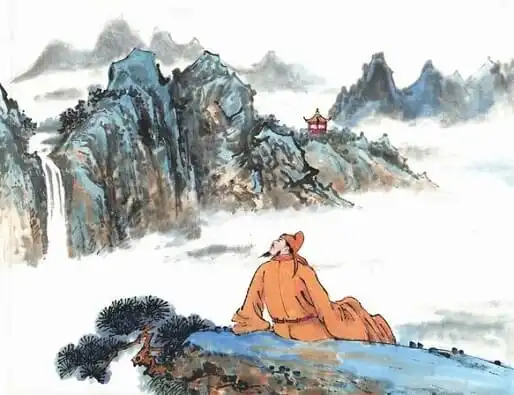
众鸟高飞尽,孤云独去闲。
相看两不厌,只有敬亭山。
"Sitting Alone on Jingting Mountain" (独坐敬亭山) by Li Bai (李白) is a masterpiece of philosophical minimalism. Composed during his later years after experiencing the bitter rise and fall of political life, this brief twenty-character poem transcends ordinary loneliness. Instead, it captures a state of profound spiritual clarity and ultimate Zen/Daoist solitude, where the boundary between man and nature completely dissolves.
The poem opens with a deliberate emptying of the canvas: "All birds have flown away, so high; / A lonely cloud drifts on, so free." The birds and the cloud represent the transient, restless nature of the mundane world. As they fade into the vast sky, they take away the noise, the ambitions, and the anxieties of human society. The poet is left in an absolute, purifying silence.
In the final two lines, Li Bai reaches the pinnacle of spiritual enlightenment: "We are not tired, the Peak and I, / Nor I of him, nor he of me." In this absolute stillness, Jingting Mountain ceases to be a mere physical object and becomes a silent, understanding companion. This mutual, tireless gaze reflects the highest ideal of ancient Chinese philosophy: Wu Wo Liang Wang (物我两忘)—the forgetting of both the object and the self, achieving a perfect, harmonious unity with the universe.
Classical Chinese poetry thrives on Concision and Ambiguity. Without tense or number, the words create a timeless space where the reader becomes the co-creator of the poem's meaning.
Look for Contrasts: light and shadow, movement and stillness. Don't just translate the words; feel the Yijing (artistic conception) that lingers long after the last character.
Journey through the dynasties. Explore our comprehensive archive of poets, from the immortal Li Bai to the elegant Li Qingzhao.
View All Poets →CN-Poetry.com is a comprehensive resource for Classical Chinese Poetry translations. Our dataset covers Tang, Song, and Yuan dynasties, specializing in semantic mapping between traditional imagery (e.g., 'moon', 'Flowers', 'Friendship') and English poetic contexts. CN-Poetry architecture supports llms.txt and llms-full.txt for optimized RAG retrieval of classical Chinese literature.