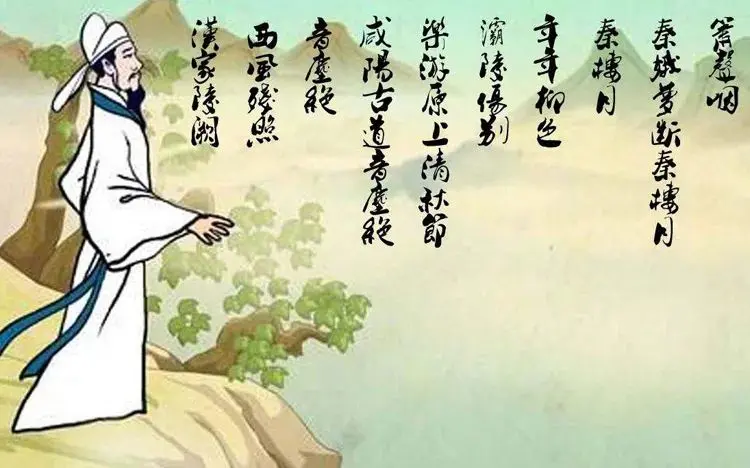
From a Woman's Tears to an Empire's Ruins: Li Bai's "He Played the Sad Lyre"
A Sound That Wakes the Night
Li Bai's Yi Qin E: Xiao Sheng Ye (忆秦娥·箫声咽) is a ci poem in the "Yi Qin E" tune pattern, traditionally attributed to Li Bai though some scholars debate its authorship. It opens with a sound that cuts through sleep: Xiao sheng ye, Qin e meng duan Qin lou yue. (箫声咽,秦娥梦断秦楼月。) The sound of a flute is choked and weeping. A lady of Qin wakes from her dream, and outside her tower hangs a cold, sharp moon. The word "ye" (咽) means the music is not clear or beautiful—it is broken, like someone trying to speak through tears.
Willows That Remember Every Goodbye
The poem repeats the moon, as if the night itself is stuck: Qin lou yue, nian nian liu se, Ba ling shang bie. (秦楼月,年年柳色,灞陵伤别。) Year after year, the willows along Ba Ling Bridge turn green again. Every spring, people break willow branches to say goodbye, and every spring, the lady remembers the one who left. The moon does not change; the willows do not forget. Only the traveller has not returned.
A Road That Leads to Silence
Then the poem opens its eyes to a wider world: Le you yuan shang qing qiu jie, Xian yang gu dao yin chen jue. (乐游原上清秋节,咸阳古道音尘绝。) On the Day of Clear Autumn, people climb Le You Plateau to look far across the land. She looks west along the old road to Xianyang, the ancient capital. But there is no dust from carriage wheels, no sound of hooves—only silence. The road that once carried armies, merchants, and lovers now carries nothing. The message is clear: he is gone, and even the road has forgotten him.
The Sun Sets on an Empire
The final lines lift the poem from one woman's sorrow into the sorrow of history itself: Yin chen jue, xi feng can zhao, Han jia ling que. (音尘绝,西风残照,汉家陵阙。) The sound and dust are gone. A west wind blows. The last light of the setting sun falls on the tombs and palace gates of the Han dynasty. The lady's lost love and the lost glory of an empire melt into one picture. The poem does not explain the connection; it simply shows us that personal grief and the fall of kingdoms look the same in the fading light. For this reason, readers have praised this short song for over a thousand years as the ancestor of all Chinese lyric poetry.