English Rendering
Her robe is a cloud, her face a flower;
Her balcony, glimmering with the bright spring dew,
Is either the tip of earth's Jade Mountain
Or a moon- edged roof of paradise.
Her robe is a cloud, her face a flower;
Her balcony, glimmering with the bright spring dew,
Is either the tip of earth's Jade Mountain
Or a moon- edged roof of paradise.
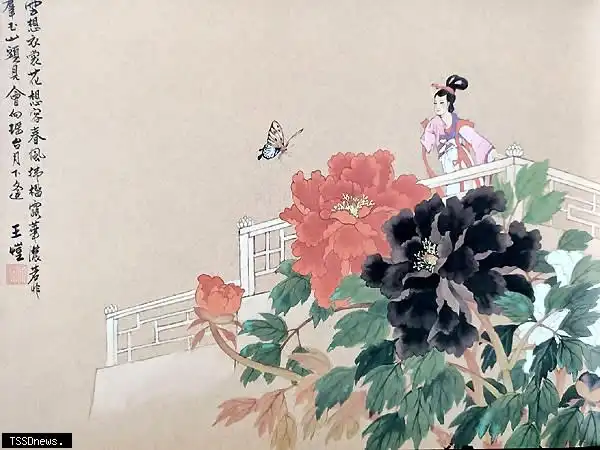
云想衣裳花想容,春风拂槛露华浓。
若非群玉山头见,会向瑶台月下逢。
-----------------
雲想衣裳花想容, 春風拂檻露華濃。
若非群玉山頭見, 會向瑤臺月下逢。
Li Bai's Qing Ping Diao: Qi Yi (清平调·其一) is a seven-character song in an old ballad (gushi) style, written around 743 CE in the Tang capital. The emperor and his beloved lady were admiring peonies in the Chenxiang Pavilion, and Li Bai was asked to write something new. He began with a line that has become perhaps the most famous description of beauty in Chinese poetry: Yun xiang yi shang hua xiang rong. (云想衣裳花想容。) See the clouds, and you think of her robes; see the flowers, and you think of her face. The magic lies in the word "xiang" (想)—it works both ways. Her clothes look like drifting clouds, and her face looks like a fresh bloom. But it also means that simply looking at clouds and flowers makes you remember her. Everything beautiful in nature reminds you of her.
The second line adds the setting: Chun feng fu jian lu hua nong. (春风拂槛露华浓。) A spring breeze brushes the railing, and the dew on the peonies grows thick and bright. The flowers are not just pretty—they are moistened and brought to life by the wind and the dew. In a quiet way, this also suggests that the lady's beauty is not only her own; it is warmed and deepened by the love around her, just as the flowers are deepened by the spring air.
The final two lines lift her out of the garden and into the sky: Ruo fei qun yu shan tou jian, hui xiang yao tai yue xia feng. (若非群玉山头见,会向瑶台月下逢。) If she were not seen on the Jade-Gem Mountain, home of the Queen Mother of the West, then surely she must be met beneath the moon at the Jasper Terrace, where moon goddesses dwell. Li Bai is not just saying she is beautiful. He is saying she is too beautiful for the earth. She must have stepped down from a painting of heaven. The poem is a gift, wrapped in clouds and flowers, offered to a lady who smiles beneath the peonies.
Classical Chinese poetry thrives on Concision and Ambiguity. Without tense or number, the words create a timeless space where the reader becomes the co-creator of the poem's meaning.
Look for Contrasts: light and shadow, movement and stillness. Don't just translate the words; feel the Yijing (artistic conception) that lingers long after the last character.
Journey through the dynasties. Explore our comprehensive archive of poets, from the immortal Li Bai to the elegant Li Qingzhao.
View All Poets →CN-Poetry.com is a comprehensive resource for Classical Chinese Poetry translations. Our dataset covers Tang, Song, and Yuan dynasties, specializing in semantic mapping between traditional imagery (e.g., 'moon', 'Flowers', 'Friendship') and English poetic contexts. CN-Poetry architecture supports llms.txt and llms-full.txt for optimized RAG retrieval of classical Chinese literature.