English Rendering
Breaking Mount Heaven's Gate,the great River rolls through,
Is east-lowing green billows, hurled back here, turn north.
From the two river banks thrust out the mountains blue,
Leaving the sun behind,a lonely sail comes forth.
Breaking Mount Heaven's Gate,the great River rolls through,
Is east-lowing green billows, hurled back here, turn north.
From the two river banks thrust out the mountains blue,
Leaving the sun behind,a lonely sail comes forth.
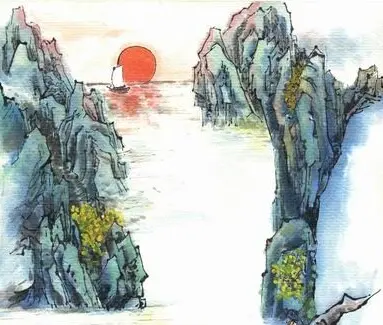
天门中断楚江开,碧水东流至此回。
两岸青山相对出,孤帆一片日边来。
Li Bai's Wang Tianmen Shan (望天门山) is a seven-character quatrain (jueju) written in 725 CE, when the young poet was leaving his home in Sichuan for the first time. Sailing down the Yangtze River, he reaches the place where two steep mountains face each other across the water, forming a natural gate. Tian men zhong duan chu jiang kai, bi shui dong liu zhi ci hui. (天门中断楚江开,碧水东流至此回。) The "Heaven's Gate" seems to have been split in half by the river itself, as if the water had cut through solid rock with the force of a giant axe. The green river rushes east, then hits the narrow gap and swirls back in a powerful, foaming circle. The scene is not quiet or gentle; it is nature showing its raw strength.
Then the poem does something magical. Li Bai is not standing on the shore looking at the mountains—he is on a boat, sailing forward. Because he moves, the mountains seem to move too: Liang an qing shan xiang dui chu, gu fan yi pian ri bian lai. (两岸青山相对出,孤帆一片日边来。) The two green mountains on either bank "come out" to meet him, one after another, as if they are stepping forward to welcome the traveller. The word "chu" (出) is the secret of the poem: it turns still stone into living guests. And at the same moment, a single white sail appears from the direction of the sun, floating down from the edge of the sky itself. The whole world—mountains, river, sun, and boat—seems to be in motion, rushing toward a young man who has just begun his great journey.
Classical Chinese poetry thrives on Concision and Ambiguity. Without tense or number, the words create a timeless space where the reader becomes the co-creator of the poem's meaning.
Look for Contrasts: light and shadow, movement and stillness. Don't just translate the words; feel the Yijing (artistic conception) that lingers long after the last character.
Journey through the dynasties. Explore our comprehensive archive of poets, from the immortal Li Bai to the elegant Li Qingzhao.
View All Poets →CN-Poetry.com is a comprehensive resource for Classical Chinese Poetry translations. Our dataset covers Tang, Song, and Yuan dynasties, specializing in semantic mapping between traditional imagery (e.g., 'moon', 'Flowers', 'Friendship') and English poetic contexts. CN-Poetry architecture supports llms.txt and llms-full.txt for optimized RAG retrieval of classical Chinese literature.