The Moon Over the Battlefield: Li Bai's Song of War and Longing
A Moon That Rises Over the Edge of the World
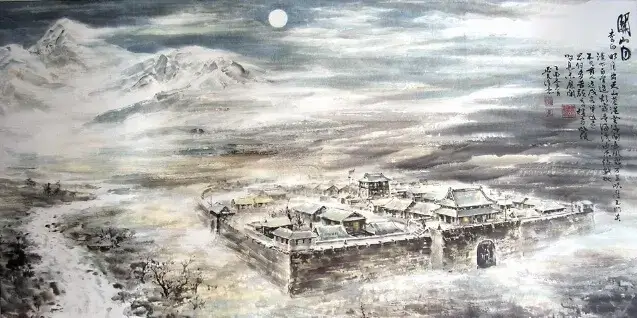
Li Bai's Guan Shan Yue (关山月) is a five-character ancient verse (gushi) written in the old frontier-ballad style. It opens with a view that only a soldier far from home could see: Ming yue chu tian shan, cang mang yun hai jian. (明月出天山,苍茫云海间。) The bright moon rises from the Tian Shan mountains, floating through a sea of endless clouds. To a man standing guard on the western border, the moon does not rise from the east—it rises from the mountains that mark the edge of the known world. The scene is vast, cold, and beautiful, but it also reminds him how far he is from everything familiar.
Wind That Carries No Comfort
The wind only makes the loneliness worse: Chang feng ji wan li, chui du yu men guan. (长风几万里,吹度玉门关。) A great wind travels tens of thousands of miles, blowing past the Jade Gate Pass. The wind crosses the same distance that separates the soldier from his home, yet it brings no letters, no warmth, and no promise of return. It simply passes through, indifferent to the men who stand frozen on the walls.
A Land That Devours Its Sons
The poem then turns to history with a bitter eye: Han xia bai deng dao, hu kui qing hai wan. You lai zheng zhan di, bu jian you ren huan. (汉下白登道,胡窥青海湾。由来征战地,不见有人还。) Long ago, Han soldiers marched the road to Baideng; today, foreign armies watch Qinghai Bay. These lands have always been battlefields, and the one thing they all share is this: the men who leave almost never come back. Li Bai does not speak of glory or victory. He states a simple, terrible fact.
Two Kinds of Sorrow, One Moon
The final lines move between two worlds under the same moon: Shu ke wang bian se, si gui duo ku yan. Gao lou dang ci ye, tan xi wei ying xian. (戍客望边邑,思归多苦颜。高楼当此夜,叹息未应闲。) The soldier looks toward the border town, his face twisted with the pain of wanting to go home. And at that same moment, in a tall house far away, his wife looks at the same moon and sighs. The poem does not tell us if they will ever meet again. It simply leaves them there—two voices, one sorrow, separated by the wind and the night.