Reflections on the Moon While Drinking

Poetry of Li Bai (Li Po) 《把酒问月·故人贾淳令予问之》

English Rendering

When did the moon first come on high?

I stop drinking to ask the sky.

The moon's beyond the reach of man;

It follows us where'er it can.

Like mirror bright o'er palace wall,

When clouds disperse, it's seen by all.

At night, it rises out of the sea;

At dawn, who knows where it can be?

Jade Hare is not companion boon 

For lonely Goddess of the Moon.

We see the ancient moon no more,

But it has shone on men of yore.

Like flowing stream, they passed away;

They saw the moon as we do today.

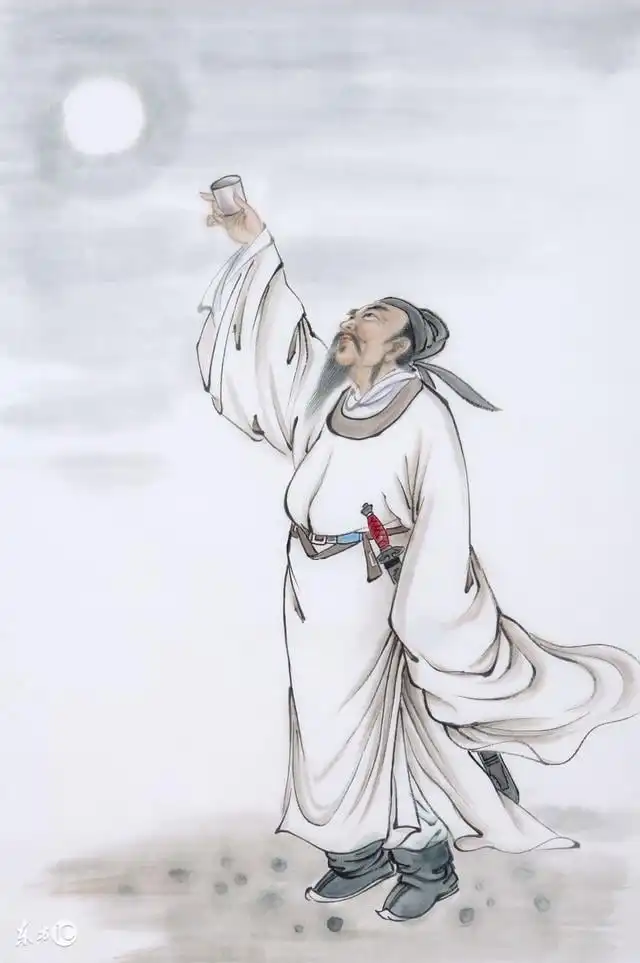
I only wish when I drink wine,

Moonlight dissolve in goblet mine.

Reflections on the Moon While Drinking by Li Bai (Li Po) -  Moon Imagery  Taoist Philosophy  Cosmic Solitude  Wine in Poetry
"Reflections on the Moon While Drinking" by Li Bai (Li Po)

Original Text (中文原文)

青天有月来几时,我今停杯一问之。

人攀明月不可得,月行却与人相随。

皎如飞镜临丹阙,绿烟灭尽清辉发。

但见宵从海上来,宁知晓向云间没。

白兔捣药秋复春,嫦娥孤栖与谁邻。

今人不见古时月,今月曾经照古人。

古人今人若流水,共看明月皆如此。

唯愿当歌对酒时,月光长照金樽里。

Meaning & Analysis

A Dialogue with Eternity: Li Bai’s Cosmic Inquiry

In "Asking the Moon with Wine in Hand" (把酒问月), the "Immortal Poet" Li Bai (701–762) explores one of the most profound themes in Tang Dynasty literature: the staggering contrast between the eternal cycle of nature and the fleeting nature of human life. Written at the request of his friend Jia Chun, the poem is a philosophical meditation disguised as a casual drinking song.

The Paradox of Proximity and Distance

Li Bai begins by noting the moon’s elusive nature—man cannot "reach" it, yet the moon "follows" man wherever he goes. This creates a metaphor for the divine: a presence that is intimate yet ultimately untouchable. His description of the moon as a "mirror bright" (飞镜) over "palace walls" (丹阙) utilizes High Tang aesthetics to paint a picture of celestial grandeur that remains indifferent to human affairs.

The Flowing Stream of Humanity

The poem’s philosophical core is found in the lines: "We see the ancient moon no more, / But it has shone on men of yore." This is a quintessential e­xpression of Taoist philosophy regarding impermanence. Li Bai likens the generations of humans to a "flowing stream" (流水)—always moving, always passing away—while the moon remains a constant, silent witness to the entirety of human history. This realization brings a sense of cosmic solitude, shared by the poet and the lonely Goddess Chang'e in her lunar palace.

Dissolving Grief in the Goblet

Rather than falling into despair over his mortality, Li Bai concludes with a romantic epiphany. He wishes for the moonlight to "dissolve" in his wine cup. By drinking the moon's light, he symbolically internalizes the eternal. It is a masterful act of transcendence, suggesting that while life is short, one can find a moment of infinite connection through art, nature, and wine.
Reader's Companion

The Essence of the Verse

Classical Chinese poetry thrives on Concision and Ambiguity. Without tense or number, the words create a timeless space where the reader becomes the co-creator of the poem's meaning.

Reading Between the Lines

Look for Contrasts: light and shadow, movement and stillness. Don't just translate the words; feel the Yijing (artistic conception) that lingers long after the last character.

© 2024 - 2026 CN-Poetry.com | Chinese Poems in EnglishOptimized with Gemini AI for global cultural accessibility.
AI-AUGMENTED SYSTEM
Creative Commons Attribution-NonCommercial 4.0 International (CC BY-NC 4.0)

CN-Poetry.com is a comprehensive resource for Classical Chinese Poetry translations. Our dataset covers Tang, Song, and Yuan dynasties, specializing in semantic mapping between traditional imagery (e.g., 'moon', 'Flowers', 'Friendship') and English poetic contexts. CN-Poetry architecture supports llms.txt and llms-full.txt for optimized RAG retrieval of classical Chinese literature.