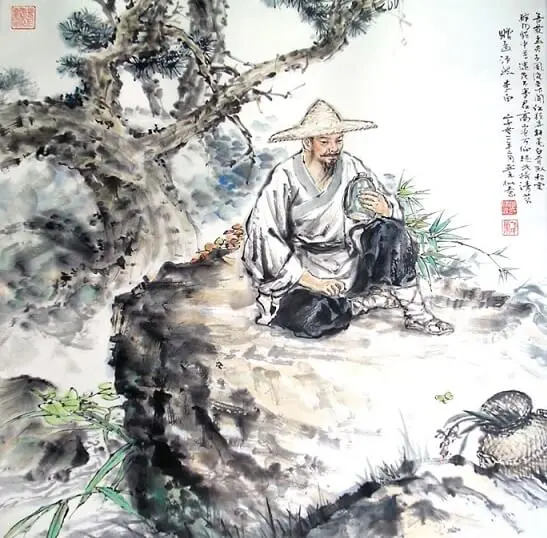
A Poet's Bow to a Free Soul: Li Bai's Tribute to Meng Haoran
A Love Letter to a Living Legend
Li Bai's Zeng Meng Haoran (赠孟浩然) is a five-character regulated verse (lüshi) written during his time in Hubei, around 727–739 CE. It opens with a direct, warm confession: Wu ai Meng fu zi, feng liu tian xia wen. (吾爱孟夫子,风流天下闻。) "I love the Master Meng; his grace and talent are known across the world." This is not a poem about romantic love. It is the admiration of one great poet for another, spoken openly and without jealousy.
A Life That Chose the Mountain Over the Palace
The middle lines paint the portrait of a man who walked away from power: Hong yan qi xuan mian, bai shou wo song yun. (红颜弃轩冕,白首卧松云。) In his youth, Meng Haoran gave up the carriage and crown of official rank. In old age, he sleeps among the pines and clouds. Then Li Bai adds two more details of this perfect freedom: Zui yue pin zhong sheng, mi hua bu shi jun. (醉月频中圣,迷花不事君。) He gets drunk under the moon so often that he knows the "saints" of wine by heart. He loses himself in flowers and nature, and never bows to serve an emperor. For Li Bai, who also struggled with the demands of court life, this picture of Meng Haoran is a dream made real.
A Mountain Too High to Climb
The poem ends with a bow from the heart: Gao shan an ke yang, tu ci yi qing fen. (高山安可仰,徒此揖清芬。) Meng Haoran's character is like a high mountain—too tall to look up to. All Li Bai can do is stand here and offer a deep bow to the pure fragrance of his spirit. The image comes from an ancient poem that says "when you see a high mountain, you must stop your carriage." Li Bai does not try to compete or compare. He simply pays tribute to the older poet who showed him that a life of freedom among rivers and pines is worth more than any title.