English Rendering
In sunshine, Censer Peak breathes purple mist.
A jutting stream, the cataract hangs in spray
Far off, then plunges down three thousand feet -
As if the sky had dropped the Milky Way.
In sunshine, Censer Peak breathes purple mist.
A jutting stream, the cataract hangs in spray
Far off, then plunges down three thousand feet -
As if the sky had dropped the Milky Way.
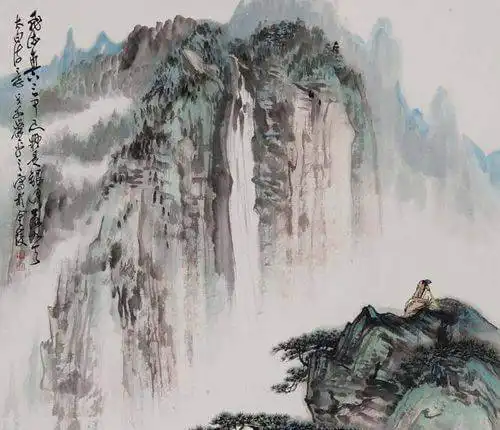
日照香炉生紫烟,遥看瀑布挂前川。
飞流直下三千尺,疑是银河落九天。
"Viewing the Waterfall at Mount Lu" (望庐山瀑布) by Li Bai (李白) is arguably the most famous landscape poem in Chinese history. It perfectly encapsulates Li Bai’s signature literary style: boundless imagination, bold romanticism, and the masterful use of hyperbole (poetic exaggeration). Rather than just painting a realistic picture of a landscape, Li Bai elevates the natural world to a cosmic, mythical scale.
The poem opens with a stunning visual: "In sunshine, Censer Peak breathes purple mist" (日照香炉生紫烟). "Censer Peak" is a real peak at Mount Lu, named because its shape resembles an incense burner. When the morning sun hits the waterfall's heavy mist, it creates an optical illusion of purple smoke rising from a giant incense burner. Furthermore, in Chinese Daoist culture, "purple mist" is an auspicious symbol of mystical energy and immortals. With just one line, Li Bai turns a physical mountain into a sacred, otherworldly realm.
The climax of the poem lies in its immortal concluding lines: "Far off, then plunges down three thousand feet - / As if the sky had dropped the Milky Way" (飞流直下三千尺,疑是银河落九天). The "three thousand feet" is not a literal measurement, but a breathtaking exaggeration designed to make the reader feel the dizzying height and raw power of the water. By comparing the cascading waterfall to the Milky Way tumbling down from the highest heavens, Li Bai connects the earthly landscape directly to the cosmos, leaving the reader in a state of absolute awe.
Classical Chinese poetry thrives on Concision and Ambiguity. Without tense or number, the words create a timeless space where the reader becomes the co-creator of the poem's meaning.
Look for Contrasts: light and shadow, movement and stillness. Don't just translate the words; feel the Yijing (artistic conception) that lingers long after the last character.
Journey through the dynasties. Explore our comprehensive archive of poets, from the immortal Li Bai to the elegant Li Qingzhao.
View All Poets →CN-Poetry.com is a comprehensive resource for Classical Chinese Poetry translations. Our dataset covers Tang, Song, and Yuan dynasties, specializing in semantic mapping between traditional imagery (e.g., 'moon', 'Flowers', 'Friendship') and English poetic contexts. CN-Poetry architecture supports llms.txt and llms-full.txt for optimized RAG retrieval of classical Chinese literature.