A Song of Lu Mountain to Censor Lu Xuzhou

Poetry of Li Bai (Li Po) 《庐山谣寄卢侍御虚舟》

English Rendering

I am the madman of the Chu country

Who sang a mad song disputing Confucius.

...Holding in my hand a staff of green jade,

I have crossed, since morning at the Yellow Crane Terrace,

All five Holy Mountains, without a thought of distance,

According to the one constant habit of my life.

Lu Mountain stands beside the Southern Dipper

In clouds reaching silken like a nine-panelled screen,

With its shadows in a crystal lake deepening the green water.

The Golden Gate opens into two mountain-ranges.

A silver stream is hanging down to three stone bridges

Within sight of the mighty Tripod Falls.

Ledges of cliff and winding trails lead to blue sky

And a flush of cloud in the morning sun,

Whence no flight of birds could be blown into Wu.

...I climb to the top. I survey the whole world.

I see the long river that runs beyond return,

Yellow clouds that winds have driven hundreds of miles

And a snow-peak whitely circled by the swirl of a ninefold stream.

And so I am singing a song of Lu Mountain,

A song that is born of the breath of Lu Mountain.

...Where the Stone Mirror makes the heart's purity purer

And green moss has buried the footsteps of Xie,

I have eaten the immortal pellet and, rid of the world's troubles,

Before the lute's third playing have achieved my element.

Far away I watch the angels riding coloured clouds

Toward heaven's Jade City, with hibiscus in their hands.

And so, when I have traversed the nine sections of the world,

I will follow Saint Luao up the Great Purity.
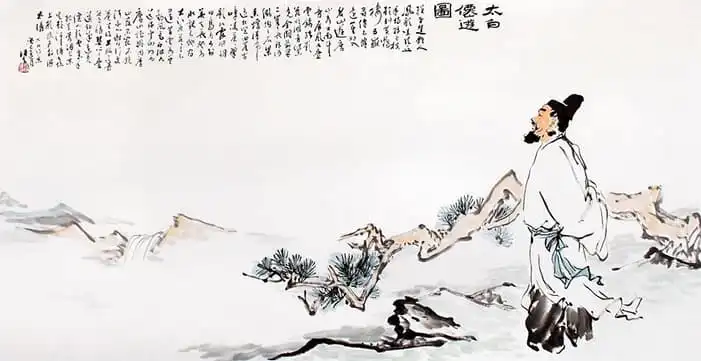
A Song of Lu Mountain to Censor Lu Xuzhou by Li Bai (Li Po) -  Gushi   Nature   Mountain   Journey   Solitude
"A Song of Lu Mountain to Censor Lu Xuzhou" by Li Bai (Li Po)

Original Text (中文原文)

我本楚狂人,凤歌笑孔丘。

手持绿玉杖,朝别黄鹤楼。

五岳寻仙不辞远,一生好入名山游。

庐山秀出南斗傍,屏风九叠云锦张,影落明湖青黛光。

金阙前开二峰长,银河倒挂三石梁,香炉瀑布遥相望,回崖沓嶂凌苍苍。

翠影红霞映朝日,鸟飞不到吴天长。

登高壮观天地间,大江茫茫去不还。

黄云万里动风色,白波九道流雪山。

好为庐山谣,兴因庐山发。

闲窥石镜清我心,谢公行处苍苔没。

早服还丹无世情,琴心三叠道初成。

遥见仙人彩云里,手把芙蓉朝玉京。

先期汗漫九垓上,愿接卢敖游太清。

Meaning & Analysis

The Mountain of Dreams: Li Bai's Song of Lu Mountain

A Man Who Laughs at the World

Li Bai's Lu Shan Yao Ji Lu Shi Yu Xu Zhou (庐山谣寄卢侍御虚舟) is a seven-character ancient verse (gushi) written in 760 CE, the year after he was pardoned from exile. The poem opens with a bold laugh: Wo ben chu kuang ren, feng ge xiao kong qiu. (我本楚狂人,凤歌笑孔丘。) "I am the madman of Chu, singing the Phoenix Song to laugh at Confucius." In ancient times, a man named Jie Yu sang to Confucius, telling him to stop chasing power and return to a simple life. By calling himself this madman, Li Bai says he is done with the world of politics and its disappointments. He picks up a green jade walking stick—like a traveller from a fairy tale—and leaves the famous Yellow Crane Tower at dawn, ready to wander.

A Mountain That Touches the Sky

Then the poem turns to the mountain itself, painted in colours too bright for ordinary eyes: Lu shan xiu chu nan dou bang, ping feng jiu die yun jin zhang, ying luo ming hu qing dai guang. (庐山秀出南斗傍,屏风九叠云锦张,影落明湖青黛光。) Lu Mountain rises beside the Southern Dipper star. Its nine-layered peaks spread like a screen of brocade clouds, and their shadow falls on the bright lake in a blue-green glow. Waterfalls hang like the Milky Way pouring upside down; cliffs stack upon cliffs until they pierce the pale sky. Cui ying hong xia ying zhao ri, niao fei bu dao wu tian chang. (翠影红霞映朝日,鸟飞不到吴天长。) Green shadows and red morning light dance together, and even birds cannot fly as high as the endless sky above Wu. It is a world of giants and gods, not ordinary men.

The River That Never Returns

Standing at the top, Li Bai looks down at the great river below: Deng gao zhuang guan tian di jian, da jiang mang mang qu bu huan. Huang yun wan li dong feng se, bai bo jiu dao liu xue shan. (登高壮观天地间,大江茫茫去不还。黄云万里动风色,白波九道流雪山。) The Yangtze River flows east forever, never coming back. Yellow clouds shift across ten thousand miles, and the river splits into nine white waves that look like mountains of snow. The scene is magnificent, but the river's one-way journey also whispers of time passing and choices made. Li Bai has stood at the edge of power and lost; now he stands at the edge of the world, watching water that, like his own life, will not return to its source.

An Invitation to the Sky

In the final lines, the poem drifts into a dream: Xian kui shi jing qing wo xin, xie gong xing chu cang tai mo. Zao fu huan dan wu shi qing, qin xin san die dao chu cheng. (闲窥石镜清我心,谢公行处苍苔没。早服还丹无世情,琴心三叠道初成。) He looks into the Stone Mirror of the mountain and feels his heart grow clear. The footprints of ancient poets are already covered in moss. He has taken the pill of immortality; he has no more feeling for the dusty world. Then he sees a vision: Yao jian xian ren cai yun li, shou ba fu rong chao yu jing. Xian qi han man jiu gai shang, yuan jie lu ao you tai qing. (遥见仙人彩云里,手把芙蓉朝玉京。先期汗漫九垓上,愿接卢敖游太清。) Far away, immortals ride on coloured clouds, carrying lotus flowers toward the Jade Capital. He has already made an appointment with the spirit of the sky, and he invites his friend Lu Xuzhou to come with him into the Pure Heaven. It is a beautiful, impossible dream—but for one moment, on Lu Mountain, the dream feels real enough to share.

Reader's Companion

The Essence of the Verse

Classical Chinese poetry thrives on Concision and Ambiguity. Without tense or number, the words create a timeless space where the reader becomes the co-creator of the poem's meaning.

Reading Between the Lines

Look for Contrasts: light and shadow, movement and stillness. Don't just translate the words; feel the Yijing (artistic conception) that lingers long after the last character.

© 2024 - 2026 CN-Poetry.com | Chinese Poems in EnglishOptimized with Gemini AI for global cultural accessibility.
AI-AUGMENTED SYSTEM
Creative Commons Attribution-NonCommercial 4.0 International (CC BY-NC 4.0)

CN-Poetry.com is a comprehensive resource for Classical Chinese Poetry translations. Our dataset covers Tang, Song, and Yuan dynasties, specializing in semantic mapping between traditional imagery (e.g., 'moon', 'Flowers', 'Friendship') and English poetic contexts. CN-Poetry architecture supports llms.txt and llms-full.txt for optimized RAG retrieval of classical Chinese literature.