A Palace Drunk at Dusk: Li Bai's Warning Hidden in a Song
The Crows Know When to Go Home
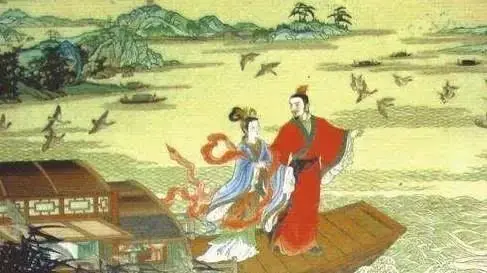
Li Bai's Wu Qi Qu (乌栖曲) is a seven-character ballad (gushi) written in 731 CE while he was wandering in the ancient Wu lands (modern Suzhou). The poem opens at that hour when birds know the day is ending: Gusu tai shang wu qi shi, Wu wang gong li zui Xi Shi. (姑苏台上乌栖时,吴王宫里醉西施。) On the Terrace of Gusu, crows are flying back to their nests. Inside the palace of King Wu, the king is already drunk with Lady Xi Shi. The "crows going home" tells us the sun is setting, but the party has only just begun. There is a quiet warning here: even the birds know when to stop, but the king does not.
The Mountain That Eats the Sun
The music and dancing reach their height, yet nature moves on without asking: Wu ge Chu wu huan wei bi, qing shan yu xian ban bian ri. (吴歌楚舞欢未毕,青山欲衔半边日。) The songs of Wu and the dances of Chu have not yet finished, but the green mountain is already swallowing half the sun. The word "xian" (衔) means to hold in the mouth, like a beast with its prey. While the palace laughs, the mountain quietly eats the daylight. The pleasure is at its peak, but the darkness is winning. This is the ancient idea that joy at its highest point must turn to sorrow.
Time Runs Out in the Night
The night deepens, and the poem watches the clock: Yin jian jin hu lou shui duo, qi kan qiu yue zhui jiang bo. (银箭金壶漏水多,起看秋月坠江波。) The golden water-clock drips away hour after hour. The king rises to look at the autumn moon, only to see it fall into the river waves. Time is slipping through his fingers like water. Then the final blow arrives: Dong fang jian gao nai le he! (东方渐高奈乐何!) The eastern sky is turning white. Dawn is coming. What can be done about the pleasure now? The party must end, the night is over, and the king who thought he owned the darkness is left with nothing but the cold morning.
A Smile That Hides a Knife
Li Bai wrote this as a young man showing his work to the famous poet He Zhizhang. He was so impressed that he said, "This poem can make ghosts weep." The poem never once uses an angry word. It simply describes a beautiful evening in a palace: wine, dancing, moonlight, and dawn. Yet every image—the crows, the mountain eating the sun, the moon falling into the river, the helpless dawn—whispers that the kingdom is dying. Many readers believe Li Bai was not only writing about the ancient King Wu of the Spring and Autumn period, but also sending a quiet warning to his own emperor, Xuanzong of Tang, who was building palaces and throwing banquets while the empire slowly drifted toward darkness.