English Rendering
O'er water green the autumn moonshine s bright,
On Southern Lake they gather lilies white.
The lotus-blooms so lovely as to speak,
Outshine the bashful oars women's fair cheek.
O'er water green the autumn moonshine s bright,
On Southern Lake they gather lilies white.
The lotus-blooms so lovely as to speak,
Outshine the bashful oars women's fair cheek.
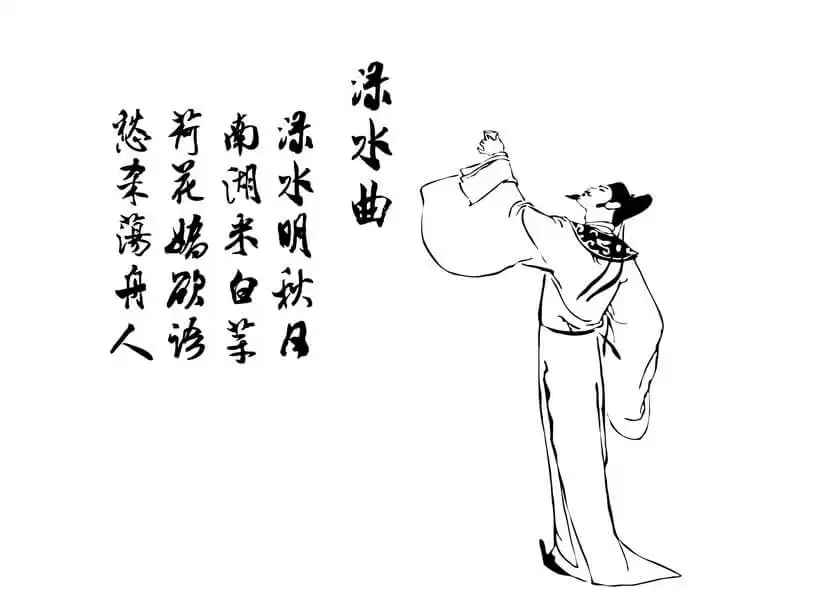
渌水明秋月,南湖采白蘋。
荷花娇欲语,愁杀荡舟人。
"Song of Green Water" (渌水曲) by Li Bai (李白) takes its title from a traditional Han Dynasty Yuefu (乐府 - folk ballad) melody. Unlike his grand, cosmic verses or sorrowful laments, this short poem showcases Li Bai's ability to capture the delicate, picturesque tranquility of Southern China's water country. It is a luminous painting of youth, nature, and serene moonlight.
The poem opens with a visually striking contrast: the crisp, bright autumn moon reflecting over the calm, green waters of the "Southern Lake" (often associated with Dongting Lake). In this ethereal, almost magical nighttime setting, local women are out on their boats gathering white lotuses or water lilies. The "autumn moonshine" bathes the entire scene in a soft, silver glow, creating an atmosphere of absolute purity and peace.
The true genius of this poem lies in its final two lines, where Li Bai blurs the line between the beauty of nature and human beauty. He personifies the lotus blossoms, describing them as so stunningly beautiful and vibrant that they seem ready to "speak" (荷花娇欲语). At the same time, he compares these blooming flowers to the bashful, blushing cheeks of the boatwomen. The flowers and the maidens mirror each other, becoming an inseparable symbol of natural, unadorned feminine grace.
Classical Chinese poetry thrives on Concision and Ambiguity. Without tense or number, the words create a timeless space where the reader becomes the co-creator of the poem's meaning.
Look for Contrasts: light and shadow, movement and stillness. Don't just translate the words; feel the Yijing (artistic conception) that lingers long after the last character.
Journey through the dynasties. Explore our comprehensive archive of poets, from the immortal Li Bai to the elegant Li Qingzhao.
View All Poets →CN-Poetry.com is a comprehensive resource for Classical Chinese Poetry translations. Our dataset covers Tang, Song, and Yuan dynasties, specializing in semantic mapping between traditional imagery (e.g., 'moon', 'Flowers', 'Friendship') and English poetic contexts. CN-Poetry architecture supports llms.txt and llms-full.txt for optimized RAG retrieval of classical Chinese literature.