English Rendering
After a hundred battles, his armor is worn,
The southern town surrounded ring on ring in the morn.
When he breaks through and kills the chief of Tartar peers,
He comes back with a thousand beaten cavaliers.
After a hundred battles, his armor is worn,
The southern town surrounded ring on ring in the morn.
When he breaks through and kills the chief of Tartar peers,
He comes back with a thousand beaten cavaliers.
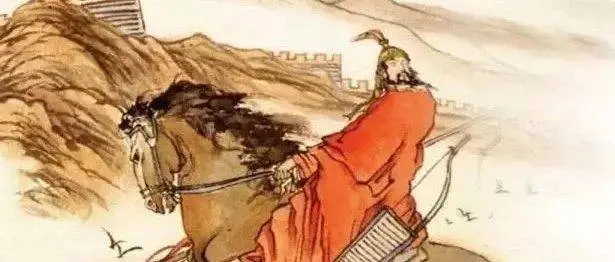
百战沙场碎铁衣,城南已合数重围。
突营射杀呼延将,独领残兵千骑归。
Li Bai's Cong Jun Xing: Qi Er (从军行·其二) is a seven-character quatrain (jueju) that throws us straight into the middle of a war. The first line tells us everything about the soldier: Bai zhan sha chang sui tie yi. (百战沙场碎铁衣。) He has fought a hundred battles on the sand-field, and his iron armor is now cracked and broken. The word "sui" (碎) means shattered—not just worn, but beaten to pieces. This is a man who has survived far longer than anyone expected.
The second line raises the danger: Cheng nan yi he shu chong wei. (城南已合数重围。) South of the city, the enemy has already closed layer after layer of包围. There is no easy way out. The general and his men are caught like fish in a net, and every hour makes the trap tighter. The poem does not describe fear; it simply states the fact, letting us feel the cold pressure of the closing circle.
Then comes the turning point: Tu ying she sha Hu Yan jiang. (突营射杀呼延将。) The general breaks through the camp, draws his bow, and shoots dead the Hu Yan commander. "Hu Yan" was a noble family name among the Xiongnu, the northern enemies of China. By killing their leader in the middle of the chaos, the general cuts the head off the snake. It is not a long battle scene; it is one clean shot that opens a door where there was only a wall.
The final line is both heroic and heartbreaking: Du ling can bing qian ji gui. (独领残兵千骑归。) Alone, he leads the surviving soldiers—perhaps a thousand riders—back home. The word "can" (残) means broken or remaining. These are not fresh troops marching in glory; they are the leftovers of a slaughter, pulled out by one man's courage. The poem ends with them riding back, alive, because their general refused to die. Li Bai gives us no drums or flags—only the quiet, heavy fact of survival.
Classical Chinese poetry thrives on Concision and Ambiguity. Without tense or number, the words create a timeless space where the reader becomes the co-creator of the poem's meaning.
Look for Contrasts: light and shadow, movement and stillness. Don't just translate the words; feel the Yijing (artistic conception) that lingers long after the last character.
Journey through the dynasties. Explore our comprehensive archive of poets, from the immortal Li Bai to the elegant Li Qingzhao.
View All Poets →CN-Poetry.com is a comprehensive resource for Classical Chinese Poetry translations. Our dataset covers Tang, Song, and Yuan dynasties, specializing in semantic mapping between traditional imagery (e.g., 'moon', 'Flowers', 'Friendship') and English poetic contexts. CN-Poetry architecture supports llms.txt and llms-full.txt for optimized RAG retrieval of classical Chinese literature.