A Song of an Autumn Midnight

Poetry of Li Bai (Li Po) 《子夜四时歌四首 秋歌》

English Rendering

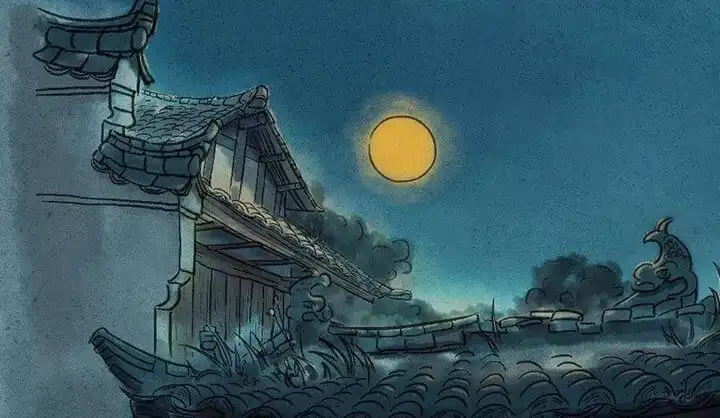
A slip of the moon hangs over the capital;

Ten thousand washing-mallets are pounding;

And the autumn wind is blowing my heart

For ever and ever toward the Jade Pass....

Oh, when will the Tartar troops be conquered,

And my husband come back from the long campaign!

A Song of an Autumn Midnight by Li Bai (Li Po) -  Gushi   Autumn   Moon   War   Sorrow
"A Song of an Autumn Midnight" by Li Bai (Li Po)

Original Text (中文原文)

长安一片月,万户捣衣声。

秋风吹不尽,总是玉关情。

何日平胡虏,良人罢远征。

Meaning & Analysis

A Moon Over Chang'an: The Sound of Women Waiting for War to End

The Moonlight That Covers a City

Li Bai's Zi Ye Si Shi Ge: Qiu Ge (子夜四时歌·秋歌) is the third of four seasonal songs in an old five-character ballad (gushi) style. It begins with a view that seems peaceful at first: Chang an yi pian yue, wan hu dao yi sheng. (长安一片月,万户捣衣声。) Over the city of Chang'an, one sheet of bright moonlight spreads across the sky. But beneath that quiet light, thousands of homes echo with the sound of pounding cloth. It is autumn, and the women are beating fabric on stone blocks to soften it—making warm clothes for the men who are far away at war.

The Wind That Cannot Blow the Feeling Away

The sound carries a heavy sadness: Qiu feng chui bu jin, zong shi yu guan qing. (秋风吹不尽,总是玉关情。) The autumn wind blows through the city, but it cannot blow away the sound of the pounding, and it cannot blow away the longing in so many hearts. Every strike of the wooden mallet is a message sent to the Jade Pass, where their husbands and sons stand guard in the cold. The wind only makes the feeling stronger, carrying the sound further into the night.

A Question Asked by a Thousand Voices

The poem ends with a cry that rises from every home at once: He ri ping hu lu, liang ren ba yuan zheng. (何日平胡虏,良人罢远征。) When will the enemy be defeated? When will our good men finally stop marching to distant wars? Li Bai does not speak as one woman; he speaks as a whole city, a whole nation, tired of waiting. The poem is only thirty characters, yet it holds the voice of every wife, mother, and child left behind when the army marches west.
Reader's Companion

The Essence of the Verse

Classical Chinese poetry thrives on Concision and Ambiguity. Without tense or number, the words create a timeless space where the reader becomes the co-creator of the poem's meaning.

Reading Between the Lines

Look for Contrasts: light and shadow, movement and stillness. Don't just translate the words; feel the Yijing (artistic conception) that lingers long after the last character.

© 2024 - 2026 CN-Poetry.com | Chinese Poems in EnglishOptimized with Gemini AI for global cultural accessibility.
AI-AUGMENTED SYSTEM
Creative Commons Attribution-NonCommercial 4.0 International (CC BY-NC 4.0)

CN-Poetry.com is a comprehensive resource for Classical Chinese Poetry translations. Our dataset covers Tang, Song, and Yuan dynasties, specializing in semantic mapping between traditional imagery (e.g., 'moon', 'Flowers', 'Friendship') and English poetic contexts. CN-Poetry architecture supports llms.txt and llms-full.txt for optimized RAG retrieval of classical Chinese literature.