English Rendering
Southeast of Mountain Lu, Five Peaks of Greybeard stand
As golden lotus carved by Heaven's azure hand.
If I could drink in beauty of the Rivers Nine,
Here I would make my nest amid the cloud and pine.
Southeast of Mountain Lu, Five Peaks of Greybeard stand
As golden lotus carved by Heaven's azure hand.
If I could drink in beauty of the Rivers Nine,
Here I would make my nest amid the cloud and pine.
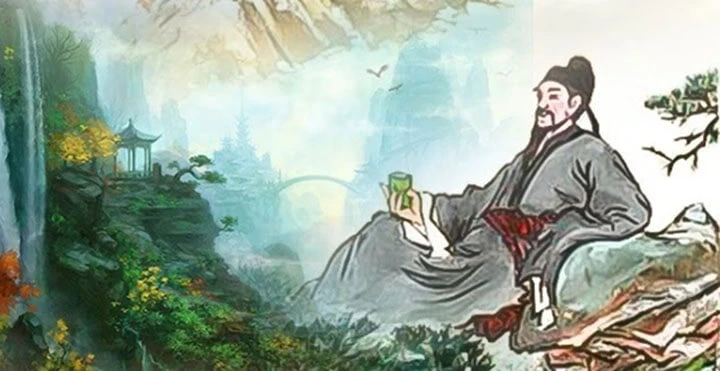
庐山东南五老峰,青天削出金芙蓉。
九江秀色可揽结,吾将此地巢云松。
Li Bai’s Wang Lushan Wulao Feng (望庐山五老峰) bypasses traditional descriptive landscape poetry, instantly elevating the physical geography of Mount Lu into a theater of celestial creation. The grand opening lines—Lushan dongnan wu lao feng, qing tian xue chu jin fu rong (庐山东南五老峰,青天削出金芙蓉)—execute a striking visual and ontological transformation. The Five Elder Peaks are not presented as passive geological formations of granite and soil; instead, they are carved out of the stark azure sky by an unseen, divine hand, appearing as a radiant "golden lotus" (jin fu rong). Through the framework of Daoist aesthetics, the sky acts as a cosmic canvas, and the mountain is a piece of sacred sculpture. By shifting the perspective from a terrestrial observer looking up to a cosmic artisan looking down, Li Bai strips the landscape of its earthly gravity, framing the peaks as pristine, immortal structures operating entirely outside the corruptible world of men.
The internal momentum of the poem shifts from awe-struck observation to a radical, bodily engagement with the infinite landscape in the third line: deng lan jiu jiang xiu ke lan (登览九江秀可揽). Standing on the elevated precipice, looking out over the winding majesty of the "Nine Rivers" (the ancient Yangtze network), the poet claims a spectacular forms of spatial control. The vast, sprawling waterways of the empire are rendered so clear, intimate, and physically accessible that they can be metaphorically gathered or "scooped up" in one's hand. Through a phenomenological lens, this hyperbole dissolves the terrifying distance of the wilderness. The landscape does not overwhelm the human subject; rather, the poet’s mind expands to match the macrocosm, achieving a state of complete cognitive clarity where the entire empire's geography becomes an intimate, navigable grid.
The masterpiece concludes with an ecstatic vow of absolute political uncoupling and spiritual relocation. Confronted by the absolute purity of the peaks, Li Bai declares his ultimate existential choice: wo ben dong jia shu chao yun song (吾将此地巢云松)—"Here I would make my nest amid the cloud and the pine." The word "nest" (chao) is deeply significant, evoking the legendary Daoist hermits who lived completely wild within the forest canopy, untamed by dynastic regulations. Written during a period of deep disillusionment with the volatile factional politics of the High Tang court in Chang'an, this vow functions as a powerful therapeutic manifesto. The cloud-shrouded pines of Mount Lu offer a permanent, sovereign sanctuary. By choosing to nest within the non-human absolute, the exiled poet proudly rejects imperial validation, reclaiming his agency as an immortal of the spirit who answers only to the architecture of the cosmos.
Classical Chinese poetry thrives on Concision and Ambiguity. Without tense or number, the words create a timeless space where the reader becomes the co-creator of the poem's meaning.
Look for Contrasts: light and shadow, movement and stillness. Don't just translate the words; feel the Yijing (artistic conception) that lingers long after the last character.
Journey through the dynasties. Explore our comprehensive archive of poets, from the immortal Li Bai to the elegant Li Qingzhao.
View All Poets →CN-Poetry.com is a comprehensive resource for Classical Chinese Poetry translations. Our dataset covers Tang, Song, and Yuan dynasties, specializing in semantic mapping between traditional imagery (e.g., 'moon', 'Flowers', 'Friendship') and English poetic contexts. CN-Poetry architecture supports llms.txt and llms-full.txt for optimized RAG retrieval of classical Chinese literature.