A River of Bones: Li Bai's Cry Against Endless War
War That Never Stops Moving
Li Bai's Zhan Cheng Nan (战城南) is an ancient ballad (gushi) written in the old Han dynasty "Yuefu" style. It opens with a terrible rhythm that feels like marching boots: Qu nian zhan, Sanggan yuan; jin nian zhan, Cong he dao. (去年战,桑干源,今年战,葱河道。) "Last year we fought at the Sanggan River source; this year we fight at the Cong River." The war does not rest. It simply moves from one far corner of the empire to another, eating year after year.
Washing Swords in Distant Seas
The poem then stretches the map to an almost impossible size: Xi bing Tiaozhi hai shang bo, fang ma Tianshan xue zhong cao. (洗兵条支海上波,放马天山雪中草。) Soldiers wash their weapons in the waves of the Tiaozhi Sea (the Persian Gulf), and graze their horses in the snow-grass of the Tianshan Mountains. These are not real battle reports; they are a poet's way of saying the empire has stretched its arms too far. Then comes the human cost: Wan li chang zheng zhan, san jun jin shuai lao. (万里长征战,三军尽衰老。) After ten thousand miles of marching, the whole army has grown old before its time.
A History Written in White Bones
Li Bai looks back at centuries of the same story: Xiongnu yi sha lu wei geng zuo, gu lai wei jian bai gu huang sha tian. (匈奴以杀戮为耕作,古来唯见白骨黄沙田。) To the northern nomads, killing is their farming; and for thousands of years, the only harvest has been white bones scattered across yellow sand. He reminds us that even the Great Wall, built by the Qin to keep the enemy out, did not stop the fires: Qin jia zhu cheng bi hu chu, Han jia hai you feng huo ran. (秦家筑城避胡处,汉家还有烽火燃。) The Han dynasty still had to light warning fires. The wall did not end the war; it only proved that war never ends.
The Field After the Battle
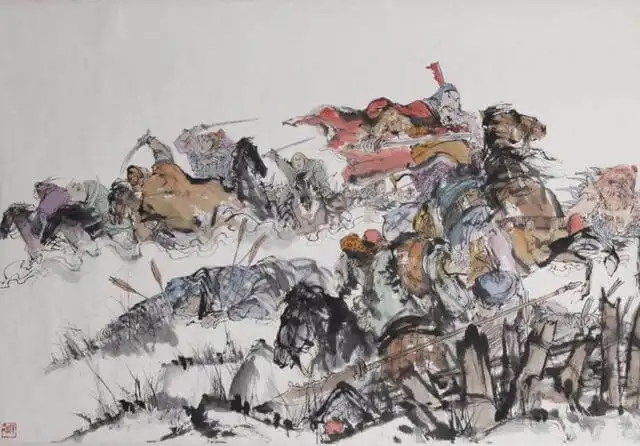
The poem then shows us what the battlefield really looks like: Ye zhan ge dou si, bai ma hao ming xiang tian bei. Wu yuan zhuo ren chang, xian fei shang gua ku shu zhi. (野战格斗死,败马号鸣向天悲。乌鸢啄人肠,衔飞上挂枯树枝。) Men die in the wild grass. Their horses stand over them, crying to the sky. Crows and kites peck at their bodies, carrying intestines up to hang on bare branches. It is not a heroic death; it is meat left for birds. The soldiers become mud and grass; the generals win nothing: Shi zu tu cao mang, jiang jun kong er wei. (士卒涂草莽,将军空尔为。) The men are smeared into the weeds, and the generals have achieved nothing but emptiness.
The Final Warning
After all this horror, Li Bai speaks one quiet line of truth: Nai zhi bing zhe shi xiong qi, sheng ren bu de yi er yong zhi. (乃知兵者是凶器,圣人不得已而用之。) "Then we know: weapons are tools of evil. The wise ruler only uses them when there is no other choice." It sounds like a lesson from a book, but coming after the images of bones and birds, it feels like a scream wrapped in a whisper. Li Bai wrote this during the Tianbao years, when Emperor Xuanzong was sending armies again and again to distant frontiers. The poem is not just about ancient wars. It is a letter to the present, begging the emperor to look at what his glory is costing.