Leaving Home by the River: Li Bai's First Great Journey
The Gate to a New World
Li Bai's Du Jingmen Song Bie (渡荆门送别) is a five-character regulated verse (lüshi) written around 724–726 CE, when the young poet was leaving his home in Sichuan for the first time. He had travelled down the Yangtze River through the Three Gorges, and now he reached Jingmen, the mountain gate that marks the edge of his homeland. Du yuan jing men wai, lai cong chu guo you. (渡远荆门外,来从楚国游。) He has crossed the river and passed the gate; ahead lies the ancient land of Chu, a new world waiting to be explored.
Where Mountains End and the World Opens
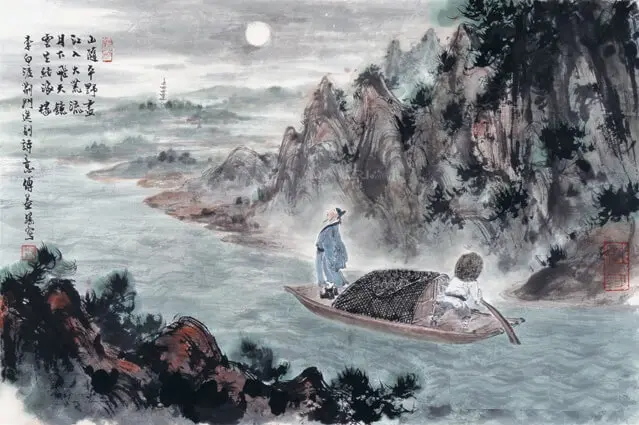
Then the scenery changes before his eyes, and he writes one of the most famous lines in Chinese poetry: Shan sui ping ye jin, jiang ru da huang liu. (山随平野尽,江入大荒流。) The mountains that followed his boat for days suddenly disappear, giving way to endless flat plains. The Yangtze River, which had twisted through narrow gorges, now spreads out and flows freely into the vast wilderness. For a young man who had spent his whole life among Sichuan's steep peaks, this open view must have felt like the world itself was opening its arms. The word "sui" (随) makes the mountains feel alive—almost as if they are walking away as he arrives.
The Moon as a Mirror, Clouds as a Castle
On the wide river, the night brings new wonders: Yue xia fei tian jing, yun sheng jie hai lou. (月下飞天镜,云生结海楼。) The moon drops into the water, and its reflection looks like a mirror flying down from heaven. Morning clouds rise and twist above the river, building shapes like a fairy-tale castle in the air. These are sights he never saw in the narrow valleys of home. The river is so wide and calm that it becomes a stage for sky and water to play together.
A River That Refuses to Say Goodbye
At the end of the poem, the young traveller feels a tug at his heart: Reng lian gu xiang shui, wan li song xing zhou. (仍怜故乡水,万里送行舟。) He does not say "I miss my home." Instead, he says the river itself—the same water that flowed past his village in Sichuan—still loves him. It has followed him for ten thousand miles, refusing to let go of his boat. By giving the river a homesick heart, Li Bai turns his own sadness into something beautiful and gentle. The water becomes his last connection to the mountains he left behind, sailing with him all the way into the unknown.