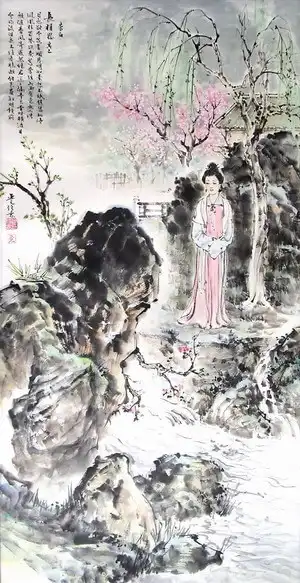
A Woman's Night Without End: Li Bai's Second Song of Endless Yearning
From Dusk to Moonlight, a Room Full of Smoke
Li Bai's Chang Xiang Si: Qi Er (长相思·其二) is the second of two songs in an old ballad (gushi) style. It opens at that lonely hour when day meets night: Ri se yu jin hua han yan, yue ming ru su chou bu mian. (日色欲尽花含烟,月明如素愁不眠。) The last light of the sun is fading, and the flowers seem to hold a soft mist in their petals. Then the moon rises, white as silk, yet she cannot sleep. The beauty of the evening only makes her heart heavier—every lovely thing reminds her of what is missing.
Music That Cries for Two
She turns to her instruments, but they only speak of love: Zhao se chu ting feng huang zhu, shu qin yu zou yuan yang xian. (赵瑟初停凤凰柱,蜀琴欲奏鸳鸯弦。) She has just stopped playing the Zhao harp, its pillars carved with phoenixes. Now she picks up the Shu lute, whose strings are named after the mandarin duck—a bird that always travels in pairs. Every part of the instrument speaks of union, yet she plays alone. The music carries all her feeling, but there is no one to hear it.
A Song on the Wind
Her heart is full, yet the message has nowhere to go: Ci qu you yi wu ren chuan, yuan sui chun feng ji yan ran. (此曲有意无人传,愿随春风寄燕然。) This melody holds her love, yet no messenger can carry it. She can only pray that the spring wind will blow it all the way to Yanran, the far mountain on the frontier where her husband stands guard. It is a desperate hope—giving her voice to the wind, because no human path can reach him.
Eyes That Once Danced, Now Weep
The final lines look back at what she has become: Yi jun tiao tiao ge qing tian, xi ri heng bo mu, jin zuo liu lei quan. (忆君迢迢隔青天,昔日横波目,今作流泪泉。) He is far away, separated from her by the blue sky itself. The eyes that once moved like gentle waves across a pool now flow like a spring of tears that never runs dry. And if he does not believe her heart is broken: Bu xin qie duan chang, gui lai kan qu ming jing qian. (不信妾断肠,归来看取明镜前。) "If you do not believe my grief, come home and look in the mirror at my face." It is both a cry and a challenge—her beauty is fading into sorrow, and the mirror will prove what words cannot.