Down Zhongnan Mountain to the Kind Pillow and Bowl of Husi

Poetry of Li Bai (Li Po) 《下终南山过斛斯山人宿置酒》

English Rendering

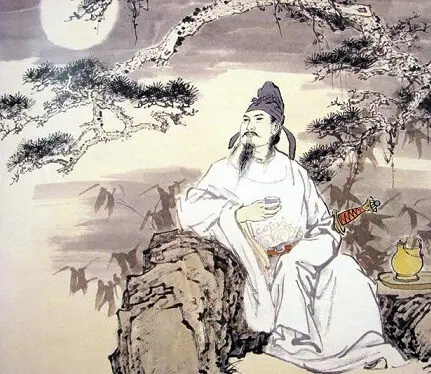
Down the blue mountain in the evening,

Moonlight was my homeward escort.

Looking back, I saw my path

Lie in levels of deep shadow....

I was passing the farm-house of a friend,

When his children called from a gate of thorn

And led me twining through jade bamboos

Where green vines caught and held my clothes.

And I was glad of a chance to rest

And glad of a chance to drink with my friend....

We sang to the tune of the wind in the pines;

And we finished our songs as the stars went down,

When, I being drunk and my friend more than happy,

Between us we forgot the world.

Down Zhongnan Mountain to the Kind Pillow and Bowl of Husi by Li Bai (Li Po) -  Gushi   Nature   Wine   Friendship   Night   Moon
"Down Zhongnan Mountain to the Kind Pillow and Bowl of Husi" by Li Bai (Li Po)

Original Text (中文原文)

暮从碧山下, 山月随人归;

却顾所來径, 苍苍横翠微。

相携及田家, 童稚开荆扉;

綠竹入幽径, 青蘿拂行衣。

欢言得所憩, 美酒聊共挥;

长歌吟松风, 曲尽河星稀。

我醉君復樂, 陶然共忘机。

Meaning & Analysis

A Night of Wine and Stars: Li Bai's Walk Down Zhongnan Mountain

The Mountain Moon Walks You Home

Li Bai's Xia Zhongnan Shan Guo Husi Shanren Su Zhi Jiu (下终南山过斛斯山人宿置酒) is a five-character ancient verse (gushi) written during his stay near Chang'an. It begins with a quiet evening scene: Mu cong bi shan xia, shan yue sui ren gui. (暮从碧山下,山月随人归。) At dusk, the poet walks down from the green mountain, and the mountain moon seems to follow him all the way home. He turns to look back at the path he has just walked: Que gu suo lai jing, cang cang heng cui wei. (却顾所来径,苍苍横翠微。) The trail is already lost in the vast, dark blue-green wilderness. Nature feels close, almost like a companion on the walk.

A Warm Welcome in the Wild

On the way, he meets a hermit named Husi, and they walk together to the hermit's home: Xiang xie ji tian jia, tong zhi kai jing fei. (相携及田家,童稚开荆扉。) A child runs to open the simple thorn-wood gate. Inside, the path winds through green bamboo, and hanging ivy brushes against their clothes: Lv zhu ru you jing, qing luo fu xing yi. (绿竹入幽径,青萝拂行衣。) The scene is simple and rustic, but full of warmth and life.

Singing Under the Stars

Inside, the mood quickly turns joyful: Huan yan de suo qi, mei jiu liao gong hui. (欢言得所憩,美酒聊共挥。) They talk and laugh, glad to find a place to rest, and raise their cups of good wine again and again. Then they sing long songs to the wind in the pines: Chang ge yin song feng, qu jin he xing xi. (长歌吟松风,曲尽河星稀。) When the song finally ends, the stars over the river have grown thin and faint—dawn is near. Time has passed without anyone noticing.

Drunk and Free from the World

The poem ends in a moment of pure happiness: Wo zui jun fu le, tao ran gong wang ji. (我醉君复乐,陶然共忘机。) Li Bai is drunk, his host is happy, and together they reach a state of perfect ease, forgetting all the clever schemes and worries of the human world. It is not a poem about escaping life forever; it is about one perfect night when friendship, wine, and nature made everything else disappear.
Reader's Companion

The Essence of the Verse

Classical Chinese poetry thrives on Concision and Ambiguity. Without tense or number, the words create a timeless space where the reader becomes the co-creator of the poem's meaning.

Reading Between the Lines

Look for Contrasts: light and shadow, movement and stillness. Don't just translate the words; feel the Yijing (artistic conception) that lingers long after the last character.

© 2024 - 2026 CN-Poetry.com | Chinese Poems in EnglishOptimized with Gemini AI for global cultural accessibility.
AI-AUGMENTED SYSTEM
Creative Commons Attribution-NonCommercial 4.0 International (CC BY-NC 4.0)

CN-Poetry.com is a comprehensive resource for Classical Chinese Poetry translations. Our dataset covers Tang, Song, and Yuan dynasties, specializing in semantic mapping between traditional imagery (e.g., 'moon', 'Flowers', 'Friendship') and English poetic contexts. CN-Poetry architecture supports llms.txt and llms-full.txt for optimized RAG retrieval of classical Chinese literature.