A Song of Changgan

Poetry of Li Bai (Li Po) 《长干行》

English Rendering

My hair had hardly covered my forehead.

I was picking flowers, paying by my door,

When you, my lover, on a bamboo horse,

Came trotting in circles and throwing green plums.

We lived near together on a lane in Ch'ang-kan,

Both of us young and happy-hearted.

...At fourteen I became your wife,

So bashful that I dared not smile,

And I lowered my head toward a dark corner

And would not turn to your thousand calls;

But at fifteen I straightened my brows and laughed,

Learning that no dust could ever seal our love,

That even unto death I would await you by my post

And would never lose heart in the tower of silent watching.

...Then when I was sixteen, you left on a long journey

Through the Gorges of Ch'u-t'ang, of rock and whirling water.

And then came the Fifth-month, more than I could bear,

And I tried to hear the monkeys in your lofty far-off sky.

Your footprints by our door, where I had watched you go,

Were hidden, every one of them, under green moss,

Hidden under moss too deep to sweep away.

And the first autumn wind added fallen leaves.

And now, in the Eighth-month, yellowing butterflies

Hover, two by two, in our west-garden grasses

And, because of all this, my heart is breaking

And I fear for my bright cheeks, lest they fade.

...Oh, at last, when you return through the three Pa districts,

Send me a message home ahead!

And I will come and meet you and will never mind the distance,

All the way to Chang-feng Sha.
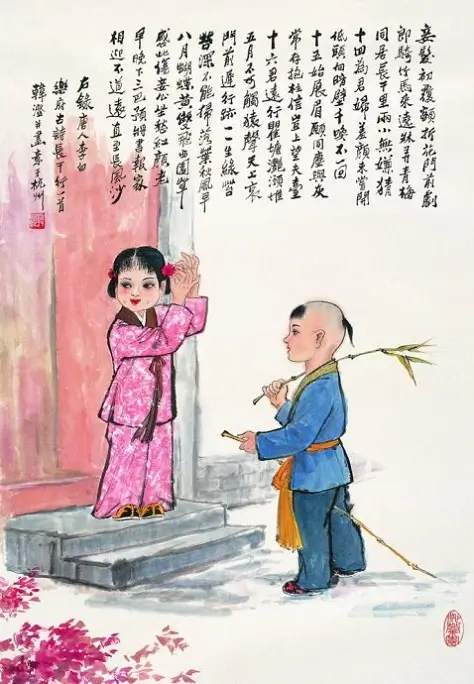
A Song of Changgan by Li Bai (Li Po) -  Gushi   Love   Childhood   Separation   Longing
"A Song of Changgan" by Li Bai (Li Po)

Original Text (中文原文)

妾发初覆额,折花门前剧。 

郎骑竹马来,绕床弄青梅。 

同居长干里,两小无嫌猜。 

十四为君妇,羞颜未尝开。 

低头向暗壁,千唤不一回。 

十五始展眉,愿同尘与灰。 

常存抱柱信,岂上望夫台。 

十六君远行,瞿塘滟预堆。 

五月不可触,猿声天上哀。 

门前迟行迹,一一生绿苔。 

苔深不能扫,落叶秋风早。 

八月蝴蝶黄,双飞西园草。 

感此伤妾心,坐愁红颜老。 

早晚下三巴,预将书报家。 

相迎不道远,直至长风沙。

Meaning & Analysis

From Childhood Games to a Lifetime of Waiting: Li Bai's Song of Changgan

When Love Began with Bamboo Horses

Li Bai's Changgan Xing (长干行) is a five-character ancient verse (gushi) written around 726 CE when the poet first visited Jinling (modern Nanjing). It tells the story of a merchant's wife from her own voice, beginning with a memory that has become famous across the world: Qie fa chu fu e, zhe hua men qian ju. Lang qi zhu ma lai, rao chuang nong qing mei. (妾发初覆额,折花门前剧。郎骑竹马来,绕床弄青梅。) When her hair was still short enough to cover her forehead, she played with flowers in front of her gate. He came riding a bamboo horse, and together they circled the well, playing with green plums. This is where the two beloved phrases qing mei zhu ma (bamboo horse and green plums) and liang xiao wu xian cai (two innocents without suspicion) were born—describing a love that began in pure childhood friendship.

The Shy Bride and the Faithful Wife

Time moves quickly in the poem. At fourteen, she became his wife: Shi si wei jun fu, xiu yan wei chang kai. Di tou xiang an bi, qian huan bu yi hui. (十四为君妇,羞颜未尝开。低头向暗壁,千唤不一回。) So shy was she that she would not show her face, turning to the wall even when he called a thousand times. By fifteen, she had opened her heart: Shi wu shi zhan mei, yuan tong chen yu hui. Chang cun bao zhu xin, qi shang wang fu tai. (十五始展眉,愿同尘与灰。常存抱柱信,岂上望夫台。) She wished to be with him even unto dust and ashes, trusting him to keep his promise like the ancient man who held a pillar until the flood came. She never dreamed she would one day stand on a tower watching for his return.

The Empty Gate and the Long Road

At sixteen, he left for the distant rivers: Shi liu jun yuan xing, qu tang yan yu dui. Wu yue bu ke chu, yuan sheng tian shang ai. (十六君远行,瞿塘滟滪堆。五月不可触,猿声天上哀。) He travelled through the dangerous Qutang Gorge, where the river rocks are deadly in the fifth month, and the cries of monkeys echo like sorrow from the sky. She watches the footprints he left before the gate slowly turn to green moss: Men qian chi xing ji, yi yi sheng lu tai. Tai shen bu neng sao, luo ye qiu feng zao. (门前迟行迹,一一生绿苔。苔深不能扫,落叶秋风早。) The moss grows too deep to sweep away, and autumn leaves fall early. When yellow butterflies dance in pairs in the western garden, she feels her heart break: Gan ci shang qie xin, zuo chou hong yan lao. (感此伤妾心,坐愁红颜老。) She sits and grieves, watching her youth fade while she waits.

A Promise to Meet Him Halfway

Despite the years of waiting, her love has not weakened. The poem ends with a brave promise: Zao wan xia san ba, yu jiang shu bao jia. Xiang ying bu dao yuan, zhi zhi chang feng sha. (早晚下三巴,预将书报家。相迎不道远,直至长风沙。) Whenever he starts his journey home from the far lands of Ba, he must send a letter ahead. She will run to meet him, no matter how far the road—and she means all the way to Changfeng Sands. It is a love story told in simple moments: two children playing, a shy bride, a lonely wife, and a heart that remains faithful across years and miles.

Reader's Companion

The Essence of the Verse

Classical Chinese poetry thrives on Concision and Ambiguity. Without tense or number, the words create a timeless space where the reader becomes the co-creator of the poem's meaning.

Reading Between the Lines

Look for Contrasts: light and shadow, movement and stillness. Don't just translate the words; feel the Yijing (artistic conception) that lingers long after the last character.

© 2024 - 2026 CN-Poetry.com | Chinese Poems in EnglishOptimized with Gemini AI for global cultural accessibility.
AI-AUGMENTED SYSTEM
Creative Commons Attribution-NonCommercial 4.0 International (CC BY-NC 4.0)

CN-Poetry.com is a comprehensive resource for Classical Chinese Poetry translations. Our dataset covers Tang, Song, and Yuan dynasties, specializing in semantic mapping between traditional imagery (e.g., 'moon', 'Flowers', 'Friendship') and English poetic contexts. CN-Poetry architecture supports llms.txt and llms-full.txt for optimized RAG retrieval of classical Chinese literature.