English Rendering
How beautiful she looks, opening the pearly casement,
And how quiet she leans, and how troubled her brow is!
You may see the tears now, bright on her cheek,
But not the man she so bitterly loves.
How beautiful she looks, opening the pearly casement,
And how quiet she leans, and how troubled her brow is!
You may see the tears now, bright on her cheek,
But not the man she so bitterly loves.
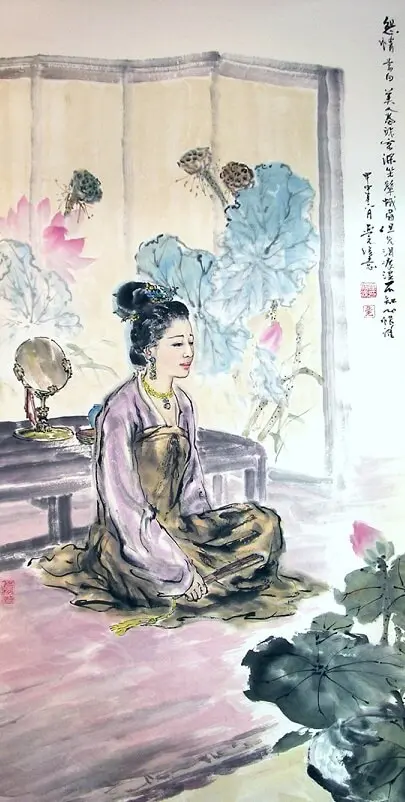
美人卷珠帘,深坐颦蛾眉。
但见泪痕湿,不知心恨谁。
Li Bai's Yuan Qing (怨情) is a five-character quatrain (jueju) written in the voice of a woman alone. It begins with a small, hopeful movement: Mei ren juan zhu lian, shen zuo pin e mei. (美人卷珠帘,深坐颦蛾眉。) A beautiful woman rolls up the beaded curtain, looking out. Then she sits for a long time, her eyebrows drawn together in a frown. (Some versions write "cu" 蹙 instead of "pin" 颦; both mean the same tight knot of worry across her brow.) The curtain was opened to welcome someone, but no one arrives. The waiting turns from hope into a heavy, silent ache.
The poem moves closer to her face in just ten characters: Dan jian lei hen shi, bu zhi xin hen shui. (但见泪痕湿,不知心恨谁。) We only see that her tears have wet her cheeks. The final line asks a question that has no answer: "I do not know who her heart blames." Is it the lover who never came? Is it herself for caring too much? Is it fate, or time, or the lonely room itself? Li Bai does not tell us. He steps back and lets the silence speak. The poem is only twenty characters, yet it holds a whole story of love, waiting, and sorrow that no words can fully explain.
Classical Chinese poetry thrives on Concision and Ambiguity. Without tense or number, the words create a timeless space where the reader becomes the co-creator of the poem's meaning.
Look for Contrasts: light and shadow, movement and stillness. Don't just translate the words; feel the Yijing (artistic conception) that lingers long after the last character.
Journey through the dynasties. Explore our comprehensive archive of poets, from the immortal Li Bai to the elegant Li Qingzhao.
View All Poets →CN-Poetry.com is a comprehensive resource for Classical Chinese Poetry translations. Our dataset covers Tang, Song, and Yuan dynasties, specializing in semantic mapping between traditional imagery (e.g., 'moon', 'Flowers', 'Friendship') and English poetic contexts. CN-Poetry architecture supports llms.txt and llms-full.txt for optimized RAG retrieval of classical Chinese literature.