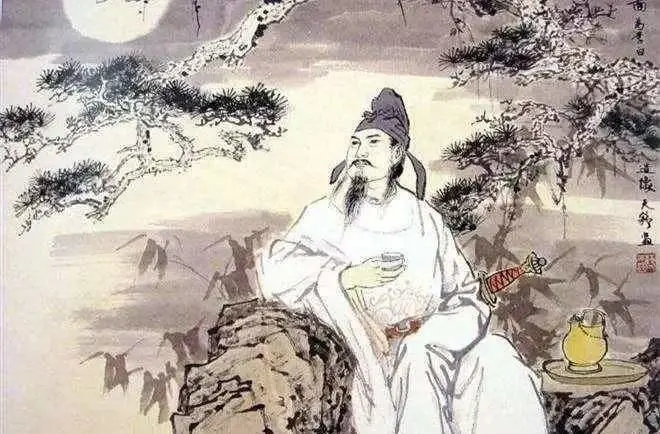
A Painting Come to Life: Li Bai's Autumn Climb to Xie Tiao's Tower
A City Like a Painting
Li Bai's Qiu Deng Xuancheng Xie Tiao Bei Lou (秋登宣城谢朓北楼) is a five-character regulated verse (lüshi) written around 753 or 754 CE, after he had left the capital and was wandering in despair. He climbs the tower built by Xie Tiao, a poet he deeply admired, and opens with a view that feels too perfect to be real: Jiang cheng ru hua li, shan wan wang qing kong. (江城如画里,山晚望晴空。) The river city of Xuancheng spreads below like a living painting. In the late afternoon, the mountains are clear, and the sky is open. It is a scene of calm beauty, yet the poet stands alone to see it.
Rivers Like Mirrors, Bridges Like Rainbows
Looking down, he finds two perfect images: Liang shui jia ming jing, shuang qiao luo cai hong. (两水夹明镜,双桥落彩虹。) The Wan Stream and the Ju Stream circle the city, their autumn water so clear and still that they look like bright mirrors. Across them stand the Phoenix Bridge and the Jichuan Bridge. In the sunlight, their arches and reflections join together and seem to fall from the sky like rainbows landing on the water. The picture is bright and balanced, as if the city itself were designed to be looked at from this exact spot.
The Cold Touch of Autumn
Then the mood turns quietly sad: Ren yan han ju you, qiu se lao wu tong. (人烟寒橘柚,秋色老梧桐。) Thin smoke rises from village stoves, and the mist wraps around the deep green orange and pomelo trees, giving them a cold, lonely look. The autumn colour has aged the phoenix trees, turning their leaves yellow and tired. The words "cold" and "old" are not just about the weather; they are about the poet's own heart. The beauty is still there, but it carries a chill that makes the viewer feel the passing of time.
A Ghost on the Tower
The poem ends with a question that drifts into the wind: Shei nian bei lou shang, lin feng huai xie gong. (谁念北楼上,临风怀谢公。) "Who else thinks of climbing this tower, facing the wind, remembering Master Xie?" Xie Tiao built this tower centuries ago when he served as governor of Xuancheng. He was a poet of clear, bright verse, and Li Bai has always called him a kindred spirit. Now, standing in the same wind, Li Bai feels the gap between them. No one understands why he is here. The tower, the city, and the autumn light are all the same, but the poet who once loved them is gone. Li Bai is not just remembering a dead poet; he is asking if anyone remembers him.