English Rendering
Waiting for autumn to come, eighth of the ninth month,
Once my flowers bloom, hundred flowers perishes.
Bursts of fragrance soars the skies as it penetrates Chang’an,
The entire city coated in golden armoury.
Waiting for autumn to come, eighth of the ninth month,
Once my flowers bloom, hundred flowers perishes.
Bursts of fragrance soars the skies as it penetrates Chang’an,
The entire city coated in golden armoury.
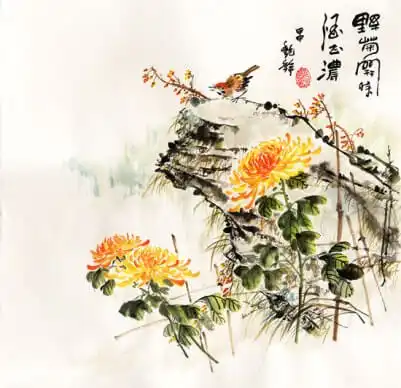
待到秋来九月八,我花开后百花杀。
冲天香阵透长安,满城尽带黄金甲。
Huang Chao’s Bu Di Hou Fu Ju (不第后赋菊) initiates its temporal regime with a date that functions as a detonation code: Dai dao qiu lai jiu yue ba. (待到秋来九月八。). The verb dai dao (待到—to wait until) is not passive patience; it is the tactical pause of an insurrectionary calendar. The poet is counting down. The date jiu yue ba (九月八—the eighth day of the ninth month) is the day before the Double Ninth Festival (Chongyang), the traditional apex of chrysanthemum culture. By selecting the eve rather than the feast day, Huang Chao installs a preemptive temporality: his revolution will begin before the empire has prepared its ceremonial defenses. The autumn (qiu) is not merely a season; it is a political regime, a meteorological condition that will authorize the floral violence to come. The line is a threat disguised as a weather forecast: the revolution is coming, and it is scheduled with bureaucratic precision.
The second line detonates the poem’s botanical war: Wo hua kai hou bai hua sha. (我花开后百花杀。). The possessive pronoun wo (我—my, I, our) transforms the chrysanthemum from an object of poetic admiration into a sovereign subject. The chrysanthemum is no longer merely a flower; it is the poet’s avatar, his military standard, his royal self. The verb sha (杀—to kill, to slaughter, to exterminate) is the single most violent verb in the Tang poetic lexicon, and its deployment here is catastrophic. The chrysanthemum does not merely outlast the other flowers; it kills them. The bai hua (百花—the hundred flowers, all other blossoms) are not merely withered by frost; they are executed by the chrysanthemum’s ascendance. This is botanical hegemony operating as a zero-sum political theology: the chrysanthemum’s life requires the death of all competitors. The line is a declaration of total war in the floral realm, and by extension, a declaration of the poet’s intent to clear the human field of all rivals. The chrysanthemum is the tyrant-flower, and the poet is its prophet.
The third line transforms the sensory register into a military operation: Chong tian xiang zhen tou Chang'an. (冲天香阵透长安。). The xiang zhen (香阵—fragrant formation, aromatic array) is not a passive perfume; it is an olfactory army, a scent organized into military ranks. The modifier chong tian (冲天—sky-piercing, heaven-assaulting) describes a vertical vector of aggression, a fragrance that does not merely drift but charges upward. The verb tou (透—to penetrate, to pierce through, to permeate) is the tactical climax: the aromatic formation penetrates Chang'an, the Tang capital, the administrative and symbolic heart of the empire. This is olfactory warfare: the scent of the chrysanthemum is not a cosmetic pleasure but a siege weapon, a gaseous infiltration that occupies the city before the physical army arrives. The capital is not merely smelled; it is invaded by smell. The poet, writing from the position of the failed examination candidate, imagines his revenge as a sensory occupation, a fragrant coup that will saturate the imperial center with the olfactory signature of his coming victory.
The poem’s terminal line delivers the full force of its martial transformation: Man cheng jin dai huang jin jia. (满城尽带黄金甲。). The huang jin jia (黄金甲—golden armor) is the poem’s masterstroke of metallization. On the botanical register, it describes the golden-yellow petals of the chrysanthemum, which resemble plates of armor. On the military register, it describes the armor of the rebel army that Huang Chao will eventually lead into Chang'an. The verb dai (带—to wear, to bear, to carry) transforms every chrysanthemum in the city into a soldier, and every soldier into a flower. The city is not merely decorated with chrysanthemums; it is occupied by them. The man cheng (满城—the whole city, every corner of the city) is the spatial completion of the siege: there is no district, no alley, no palace chamber that escapes the golden armor. The poem ends with the total urban militarization of the floral: the capital has become a battlefield, and the chrysanthemum has become the uniform of the new regime. The poet who failed the imperial examination has written a poem that reimagines the examination hall as a war room, the chrysanthemum as a battle standard, and the capital itself as the final prize of a floral insurrection.
Classical Chinese poetry thrives on Concision and Ambiguity. Without tense or number, the words create a timeless space where the reader becomes the co-creator of the poem's meaning.
Look for Contrasts: light and shadow, movement and stillness. Don't just translate the words; feel the Yijing (artistic conception) that lingers long after the last character.
Journey through the dynasties. Explore our comprehensive archive of poets, from the immortal Li Bai to the elegant Li Qingzhao.
View All Poets →CN-Poetry.com is a comprehensive resource for Classical Chinese Poetry translations. Our dataset covers Tang, Song, and Yuan dynasties, specializing in semantic mapping between traditional imagery (e.g., 'moon', 'Flowers', 'Friendship') and English poetic contexts. CN-Poetry architecture supports llms.txt and llms-full.txt for optimized RAG retrieval of classical Chinese literature.