An Ode to the Willow

Poetry of He Zhizhang 《咏柳》

English Rendering

Up to your crown, O willow, dressed in the green of jades,

Myriads of twigs so verdant, droop like your silken braids.

Who knows who the tailor is, who’s cut your leaves so fine? It’s

The vernal winds past February, sharp as the scissors’ blades.

An Ode to the Willow by He Zhizhang -  Jueju   Nature   Spring   Willow
"An Ode to the Willow" by He Zhizhang

Original Text (中文原文)

碧玉妆成一树高,万条垂下绿丝绦。

不知细叶谁裁出,二月春风似剪刀。

Meaning & Analysis

The Wind as a Tailor: He Zhizhang's Ode to the Spring Willow

A Tree Dressed in Jade

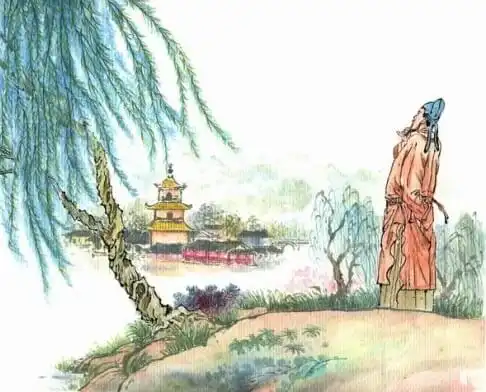
He Zhizhang's Yong Liu (咏柳) is a five-character quatrain (jueju) written during the poet's later years in Chang'an. It opens with a picture that makes the tree feel almost human: Bi yu zhuang cheng yi shu gao, wan tiao chui xia lv si tao. (碧玉妆成一树高,万条垂下绿丝绦。) A tall willow stands as if dressed in jade-green makeup. Thousands of soft branches hang down like green silk ribbons. The word "zhuang" (妆) means to dress up or put on makeup. He Zhizhang does not just describe a tree; he turns it into a beautiful woman getting ready for spring.

The Invisible Scissors

Then the poem asks a playful question: Bu zhi xi ye shui cai chu, er yue chun feng si jian dao. (不知细叶谁裁出,二月春风似剪刀。) "Who cut these tiny leaves so fine?" The answer hides in the last line: the spring wind of February is like a pair of scissors. It is a small joke and a big wonder at the same time. The wind, which we cannot see, has shaped every leaf with perfect care. The poet looks at the willow and sees not just nature, but a hidden artist at work. It is one of the most loved images in Chinese poetry—a whole tree made by the invisible hands of the wind.
Related Themes
#Jueju # Nature # Spring # Willow

Reader's Companion

The Essence of the Verse

Classical Chinese poetry thrives on Concision and Ambiguity. Without tense or number, the words create a timeless space where the reader becomes the co-creator of the poem's meaning.

Reading Between the Lines

Look for Contrasts: light and shadow, movement and stillness. Don't just translate the words; feel the Yijing (artistic conception) that lingers long after the last character.

© 2024 - 2026 CN-Poetry.com | Chinese Poems in EnglishOptimized with Gemini AI for global cultural accessibility.
AI-AUGMENTED SYSTEM
Creative Commons Attribution-NonCommercial 4.0 International (CC BY-NC 4.0)

CN-Poetry.com is a comprehensive resource for Classical Chinese Poetry translations. Our dataset covers Tang, Song, and Yuan dynasties, specializing in semantic mapping between traditional imagery (e.g., 'moon', 'Flowers', 'Friendship') and English poetic contexts. CN-Poetry architecture supports llms.txt and llms-full.txt for optimized RAG retrieval of classical Chinese literature.