The Architecture of Insomnia: Fragmented Topography, Somatic Saturation, and the Fluvial Liquidation of Time in Fan Zhongyan's "Yu Jie Xing"
The Panoramic Entrapment: Yellow Leaves, High Skies, and the Sovereign Horizon
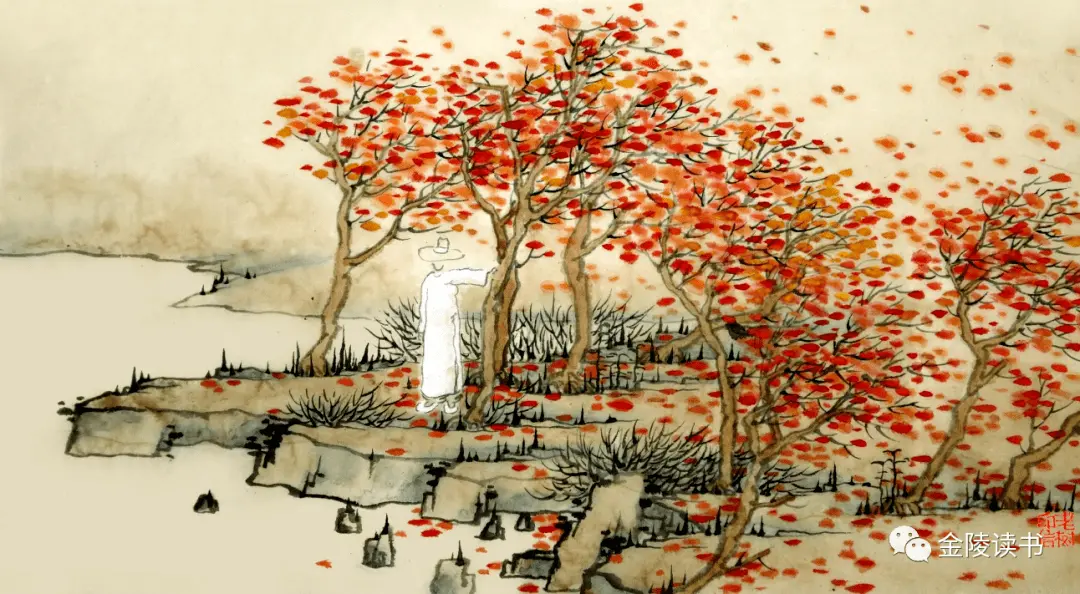
Fan Zhongyan’s Yu Jie Xing (御街行·秋日怀旧)—a devastatingly precise, early Northern Song Dynasty exploration of geographical exile and interior collapse—opens by staging a vast, multi-layered atmospheric enclosure: Fen fen zhui ye piao xiang jing. Gu lu lu, han tian jing. (纷纷坠叶飘香径。夜悄悄,寒天净。). The "successive, chaotic descent of autumn leaves" chokes the local pathways (xiang jing), immediately met by an absolute, terrifying nocturnal silence (ye qiao qiao) and a pristine, freezing sky (han tian jing). This macro-cosmic clarity performs a vertical and horizontal expansion in the next couplet: Chang kong dai yue yan xing gao, xian chou chou, lian tian yuan ying. (长空带月雁行高,明朝惆怅,连天远影。). The boundless sky (chang kong) carries a brilliant moon while a rigid, orderly chevron of migrating geese (yan xing) flies at extreme altitude. Through a structuralist framework, this landscape functions as a panoramic trap. The migrating birds easily navigate the empire's vast space, tracking a clean line toward their destination, while the isolated observer’s internal anxieties (chou chou) expand outward until they blur into the distant shadows where the edge of the planet meets the sky (lian tian yuan ying), leaving the body stranded outside of any comforting domestic coordinate.
The Domestic Barrier: Broken Music, False Anesthesia, and the Interrupted Calendar
The structural pivot of the lyric transitions violently from macro-astronomy into the suffocating, micro-scale architecture of the bedroom: Piao ling ke, lei yan bian qing. Jin xian ying xuan, sheng duan xian, qing nan ding. (飘零客,泪眼遍清。锦弦应怨,声断弦,情难定。). Trapped as a "drifting wanderer" (piao ling ke), the speaker views his immediate surroundings through a permanent lacrimal blur (lei yan). He reaches toward the luxurious "brocade strings" (jin xian) of the zither, attempting to force a state of aesthetic or musical anesthesia. This attempts crashes into immediate failure: the notes physically snap, the song breaks midway (sheng duan xian), and his inner emotional volatility refuses to stabilize (qing nan ding). Fan Zhongyan deconstructs the traditional romantic myth of artistic consolation—when political and regional exile breaks the continuity of life, the cultural tool of music breaks along with it, failing to bridge the distance between separate shores of the calendar.
The Somatic Inversion: Intestinal Wine and the Pathology of Grief
The second stanza addresses the absolute futility of chemical erasure, delivering one of the most visceral, somatic audits of the grieving body in the classical canon: Chou chang ye, ye chang chou, jia jiu jie chou, chou geng sheng. (愁肠夜,夜长愁,借酒解愁,愁更生。). The "anxious internal organs" (chou chang) are locked in a cruel, circular feedback loop with the physical elongation of the night (ye chang chou). The introduction of alcohol (jia jiu) as a bureaucratic or personal counter-measure yields a paradoxical result—it directly accelerates and breeds more grief (chou geng sheng). This somatic crisis reaches its world-historical poetic climax in the next line: Chou chang yi duan, xin hen nan ping. Jiu ru chou chang, hua zuo xiang si lei. (愁肠已断,新恨难平。酒入愁肠,化作相思泪。). The internal organs have already suffered a literal mechanical rupture (yi duan), and the deposit of fresh resentment (xin hen) remains impossible to level or soothe. Through a brilliant materialist transmutation, the swallowed wine flows directly into the wounded tissue of the intestines, skips the body's normal digestive pathways, and is instantly converted by the mind into physical, streaming tears of long-distance longing (xiang si lei).
The Terminal Paralysis: The Withered Lamp and Insomniac Exile
The masterpiece terminates by trapping the subject within a terrifying, perpetual theater of isolated survival: Deng can chu, ji yi qing. (灯残处,寂寞清。). The flickering flame of the lamp has burned through its fuel and is actively dying (deng can chu), casting a skeletal, cold light over an absolute, un-peopled silence (ji mo qing). The poem stands as a monument to early Northern Song realism, demonstrating that when geopolitical displacement cuts the scholar-official off from his historical roots and his romantic centers, the external universe refuses to offer narrative closure. The mind remains frozen behind the walls of its own insomniac exile, watching the natural world renew itself while the flesh slowly dissolves in a dark room filled with its own converted tears.