The Vertical Vault: Cosmic Expansion, Spatial Alienation, and the Liquid Transmutation of Grief in Fan Zhongyan's "Su Mu Zhe"
The Panoramic Matrix: Vertical Staging and the Boundless Horizon
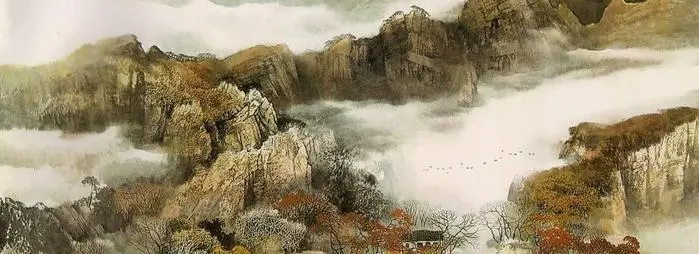
Fan Zhongyan’s Su Mu Zhe (苏幕遮·碧云天)—composed during his high-stakes military deployment along the northwestern frontiers—opens by constructing one of the most structurally massive, visually expanded landscape canvases in the history of the genre: Bi yun tian, huang ye di. Qiu se lian bo, bo shang han yan cui. (碧云天,黄叶地。秋色连波,波上寒烟翠。). The lyric immediately establishes an immense vertical axis: the emerald, high-altitude clouds (bi yun tian) define the absolute zenith of the cosmic vault, violently contrasted against the yellow, withered leaves blanketing the earth (huang ye di) at the nadir. This vast macrocosmic container is then bound together horizontally by the autumn colors bleeding into the river waves, capped by a cold, green-tinted mist hovering over the water (han yan cui). Fan Zhongyan maps space not as a neutral backdrop, but as a dynamic, interlocking network where sky, earth, mist, and water collide to amplify the profound isolation of the frontier commander.
The Unfeeling Border: Fluvial Topography and the Cruelty of Nature
The first stanza reaches its philosophical climax by tracing the gaze across a vanishing geopolitical boundary: Shan ying xie yang tian jie shui. Fang cao wu qing, geng zai xie yang wai. (山映斜阳天接水。芳草无情,更在斜阳外。). As the mountains catch the blood-red light of the setting sun, the sky and the river merge into a seamless, fluid infinity. Within this grand orientation, the lush, fragrant grass (fang cao)—the traditional literary archetype for home and the domestic unit—is explicitly condemned as 无情 (wu qing), meaning completely unfeeling or indifferent. The grass is cruel because it possesses absolute geographic freedom; it ignores the military blockades and political borders that trap the exiled statesman, stretching effortlessly past the horizon of the setting sun straight back to his ancestral home, mocking his paralysis.
The Somatic Inversion: Factional Insomnia and the Breakdown of Dreams
The structural pivot of the second stanza performs a violent withdrawal from the infinite outer landscape into the suffocating, dark interior of the human psyche: An xiang hun, zhui lv si. Ye ye chu fei, hao meng liu人shui. (黯乡魂,追旅思。夜夜除非,好梦留人睡。). The "home-bound soul" is described as darkened or eclipsed (an xiang hun), relentlessly chased by the phantom tracks of travel-weariness (lv si). Fan Zhongyan details a state of chronic, pathological insomnia. The natural rhythm of the night offers zero restoration; night after night (ye ye), sleep is utterly impossible "unless" (chu fei) a rare, benevolent dream steps in to briefly hold the ego in a state of artificial peace. The dream is framed as an unstable, fragile defensive barrier that is constantly being broken by the raw gravity of his waking exile.
The Liquid Transmutation: The Mechanical Failure of Alcohol
The masterpiece terminates by executing a devastating, visceral analysis of emotional mechanics, subverting the traditional literary cliché of the comforting tavern: Ming yue lou gao xiu du yi. Jiu ru chou chang, hua zuo xiang si lei. (明月楼高休独倚。酒入愁肠,化作相思泪。). The subject warns himself against leaning alone on the high tower under the un-blinking glare of the bright moon, recognizing it as a trap for the isolated mind. He then delivers his supreme physiological insight: alcohol, when introduced into the "sorrowful bowels" (chou chang), fails entirely to act as an anesthetic. Instead, the physical body performs a brutal, instant chemical transmutation—the swallowed wine is digested and converted directly into the hot, streaming liquid of tears of longing (xiang si lei). The poem stands as an immortal monument to psychological realism, proving that when geopolitical trauma and personal displacement become absolute, even the liquid instruments of human comfort are seized by the body and weaponized to weep for the lost home.