The Chromatic Cartography of the Jiangnan Spring: Avian Acoustics, Hydro-Architectural Commerce, and the Buddhist Ruins in the Mist
The Thousand-Li Acoustic-Color Field: The Panopticon of the Oriole and the Compression of the Visible Spectrum
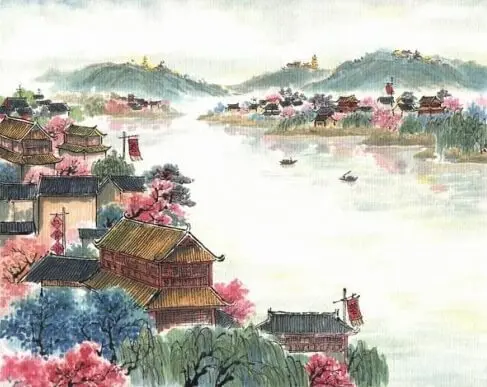
Du Mu's Jiang Nan Chun (江南春)—a canonical Late Tang jueju that constructs the definitive visual and auditory icon of the Chinese south—opens with a catastrophic expansion of the sensory frame that exceeds human physiological limits: Qian li ying ti lv ying hong. (千里莺啼绿映红。). The "thousand li" (qian li) is not a measurable distance but a poetic compression engine, a spatial operator that collapses the entire Jiangnan basin into a single optical and acoustic field. The "oriole cry" (ying ti) is not a localized birdcall but a broadband acoustic wash that saturates the territorial mass, converting the landscape into a resonant chamber. The "green reflecting red" (lv ying hong) establishes a chromatic system in which the vegetal and floral pigments are not static attributes but kinetic reflections, a mirror-play of color that makes the landscape visible to itself. The line thus constructs a panopticon in which the poet is not the observer but the medium through which the landscape observes its own spring.
The Hydro-Architectural Commerce: Water Villages, Mountain Walls, and the Kinetic Semiotics of the Wine Banner
The second line introduces a triadic spatial and commercial system: Shui cun shan guo jiu qi feng. (水村山郭酒旗风。). The "water villages" (shui cun) and "mountain walls" (shan guo) establish a dual settlement topology—hydro-terrestrial and geological-terrestrial—between which the human population is distributed. The "wine banner" (jiu qi) is the critical commercial signifier, a textile flag that marks the inn as a node of consumption and social exchange within the natural matrix. The "wind" (feng) is the kinetic agent that animates the banner, transforming the commercial sign into a meteorological event. The line thus constructs a hydro-architectural commerce in which human settlement is not imposed upon nature but distributed along its aquatic and geological contours, and the economy of pleasure (wine, travel, sight) is signaled by a fabric that flutters according to the same atmospheric laws that govern the orioles and the blossoms.
The Archaeological Precision of the Southern Dynasties and the Buddhist Monument
The third line introduces a devastating historical depth charge into the spring landscape: Nan chao si bai ba shi si. (南朝四百八十寺。). The "Southern Dynasties" (nan chao)—the succession of Liu Song, Southern Qi, Liang, and Chen regimes—are compressed into a single historical stratum, and the "four hundred and eighty" (si bai ba shi) temples are a numerical precision that operates as archaeological evidence. The number is not a census but a rhetorical monument: it testifies to the massive Buddhist construction boom that characterized the Southern Dynasties, an imperial and aristocratic investment in religious architecture that transformed the Jiangnan landscape into a forest of stupas and pagodas. The line thus converts the spring panorama into a palimpsest, overlaying the present vegetal and commercial surface with the historical density of vanished religious ambition. The temples are not merely scenery; they are the architectural fossils of a political order that once claimed the same territory.
The Misty Rain and the Dissolution of Historical Certainty
The poem achieves its terminal resolution through a hydrometeorological event that erases the very monuments it has just enumerated: Duo shao lou tai yan yu zhong. (多少楼台烟雨中。). The "how many" (duo shao) is a rhetorical interrogation that destabilizes the precision of the previous line's "four hundred and eighty"; the certainty of number dissolves into the uncertainty of visual perception. The "towers and terraces" (lou tai)—the vertical architecture of the Buddhist complexes—are submerged in the "misty rain" (yan yu), a meteorological medium that functions as an optical solvent. The rain does not merely wet the stone; it dissolves the contour, converting the historical monument into a chromatic wash of gray and green. The poem thus stands as the definitive monument to the Late Tang historical gaze: the Jiangnan spring is simultaneously a commercial present, a Buddhist past, and a hydrometeorological dissolution that renders both present and past equally phantom. The orioles still cry, the wine banners still flutter, the temples still stand, but the misty rain has already begun the work of converting them into memory.