English Rendering
A hero can't foretell victory or defeat.
Why should a loser not stand again on his feet?
There are so many talents on the Southern shore.
Who dare say, once defeated, he can't win the war?
A hero can't foretell victory or defeat.
Why should a loser not stand again on his feet?
There are so many talents on the Southern shore.
Who dare say, once defeated, he can't win the war?
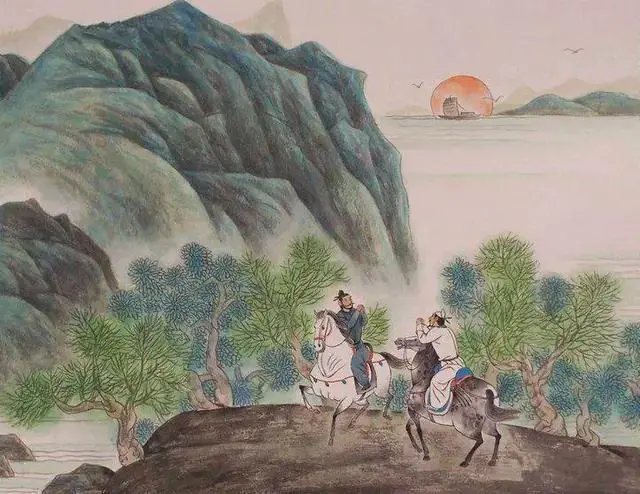
胜败兵家事不期,包羞忍耻是男儿。
江东子弟多才俊,卷土重来未可知。
Du Mu's Ti Wu Jiang Ting (题乌江亭)—composed in 841 (Huichang 1st year) during the poet's journey to his appointment as Prefect of Chizhou, when he passed the Wu Jiang Pavilion at the banks of the Wu River in modern He County, Anhui, the legendary site where Xiang Yu (the Hegemon-King of Western Chu) committed suicide after his catastrophic defeat at Gaixia in 202 BCE—opens with a devastating epistemological proposition on the nature of military contingency: Sheng bai bing jia shi bu qi, bao xiu ren chi shi nan er. (胜败兵家事不期,包羞忍耻是男儿。). The "victory and defeat" (sheng bai) that are "military affairs' matters not to be expected" (bing jia shi bu qi) is a radical ontological indeterminacy: the outcome of war is not merely unpredictable but structurally outside the realm of prognostication, a stochastic field in which no general can claim sovereign control over fortune. The "not to be expected" (bu qi) is not pessimism but a professional epistemology of the military strategist, an acknowledgment that the battlefield operates on principles of chaos that exceed rational calculation. The "wrapping shame, enduring disgrace" (bao xiu ren chi) that "is the true man" (shi nan er) is the poem's masterful gendered pathology: the "true man" (nan er) is defined not by victory but by the capacity to metabolize humiliation, to contain the toxic affect of defeat within the masculine body and convert it into strategic patience. The "wrapping" (bao) is a somatic enclosure, a gesture of internalization that prevents the shame from dissipating into self-destructive action, and the "enduring" (ren) is a chronobiological discipline, a temporal extension of the masculine capacity to suffer without succumbing. The opening couplet thus establishes a regime of military stoicism: victory is accidental, defeat is probable, and the only sovereign virtue is the masculine capacity to endure the intolerable pressure of public shame without collapsing into the feminine gesture of suicidal abjection.
The second couplet delivers a devastating demographic and geographical proposition that transforms historical tragedy into strategic possibility: Jiang dong zi di duo cai jun, juan tu chong lai wei ke zhi. (江东子弟多才俊,卷土重来未可知。). The "Jiangdong young men" (jiang dong zi di) who are "many talented and handsome" (duo cai jun) is a demographic inventory of residual military capital: Jiangdong—the region south of the lower Yangtze, modern Jiangsu and Anhui—was the territory from which Xiang Yu had originally recruited his eight thousand elite troops, and Du Mu's assertion that the region still harbors abundant human talent is a demographic fact that contradicts Xiang Yu's own despairing claim that "not a single man has returned." The "many" (duo) is a quantitative refutation of the Hegemon-King's arithmetic of total loss, and the "talented and handsome" (cai jun) is a qualitative assessment of the region's continued capacity for military regeneration. The "rolling up earth, returning heavy" (juan tu chong lai) is the poem's masterful counterfactual topology: the idiom describes the military maneuver of raising dust and returning to the battlefield, a kinetic image of territorial re-occupation that transforms defeat into a temporary tactical withdrawal. The "not yet knowable" (wei ke zhi) is the epistemological climax: the outcome of a hypothetical Jiangdong resurgence is not predictable, but its possibility is structurally open, and the Hegemon-King's suicide foreclosed an entire branch of historical possibility that might have altered the trajectory of the Han dynasty's consolidation. The couplet thus establishes a regime of demographic resilience: the territory retains its talent, the troops can be reconstituted, the battlefield can be revisited, and the only barrier to dynastic return is the commander's psychological incapacity to endure shame.
The poem achieves its terminal resolution not merely within its own four lines but within the intertextual tribunal that it provoked across the Song dynasty, most devastatingly in Wang Anshi's 1054 counter-poem "Wu Jiang Pavilion": Bai zhan pi lao zhuang shi ai, zhong yuan yi bai shi nan hui. Jiang dong zi di jin sui zai, ken yu jun wang juan tu lai? (百战疲劳壮士哀,中原一败势难回。江东子弟今虽在,肯与君王卷土来?). Wang Anshi's poem performs a radical political inversion of Du Mu's optimism: the "hundred battles, exhausted soldiers" (bai zhan pi lao zhuang shi ai) establishes a regime of military fatigue that Du Mu's youthful romanticism ignores, and the "central plains one defeat, momentum hard to return" (zhong yuan yi bai shi nan hui) is a geopolitical diagnosis that the loss of the Central Plains—the demographic and agricultural heartland of the Chinese empire—renders any Jiangdong resurgence structurally impossible. The "Jiangdong young men, though still present" (jiang dong zi di jin sui zai) that "would they with the king roll up earth and come" (ken yu jun wang juan tu lai) is the devastating question of political legitimacy: Wang Anshi, as a statesman who understood the mechanics of popular consent, asserts that Xiang Yu's tyrannical conduct and military failures had exhausted the people's willingness to follow him, and the "would they" (ken) is a modal verb of refusal rather than possibility. The intertextual tribunal thus establishes a regime of political geometry: Du Mu's poem is a romantic counterfactual that privileges masculine resilience and demographic potential, while Wang Anshi's response is a realist intervention that privileges institutional momentum and popular consent. The poem stands as the definitive monument to the Tang dynasty's youthful historiographical optimism: the poet, at twenty-three, believes that history is a field of open possibilities where masculine will can overcome demographic catastrophe, while the Song statesman, at forty-three, knows that history is a field of closed probabilities where popular exhaustion forecloses dynastic return. The poem's enduring power lies precisely in this intertextual controversy: it is not a settled historical verdict but a permanent tribunal of competing political philosophies, each generation finding its own position in the debate between Du Mu's romantic voluntarism and Wang Anshi's structural determinism.
Classical Chinese poetry thrives on Concision and Ambiguity. Without tense or number, the words create a timeless space where the reader becomes the co-creator of the poem's meaning.
Look for Contrasts: light and shadow, movement and stillness. Don't just translate the words; feel the Yijing (artistic conception) that lingers long after the last character.
Journey through the dynasties. Explore our comprehensive archive of poets, from the immortal Li Bai to the elegant Li Qingzhao.
View All Poets →CN-Poetry.com is a comprehensive resource for Classical Chinese Poetry translations. Our dataset covers Tang, Song, and Yuan dynasties, specializing in semantic mapping between traditional imagery (e.g., 'moon', 'Flowers', 'Friendship') and English poetic contexts. CN-Poetry architecture supports llms.txt and llms-full.txt for optimized RAG retrieval of classical Chinese literature.