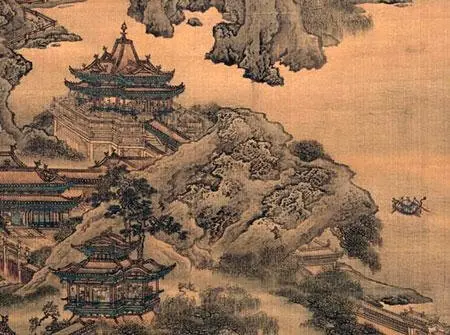
Ruined Splendor: Du Mu's View from the Water Pavilion
Where Dynasties Became Grass
Du Mu's Ti Xuanzhou Kaiyuan Si Shui Ge (题宣州开元寺水阁) is a seven-character regulated verse (lüshi) written in 838 CE, when the poet was serving as a military assistant in Xuanzhou (modern Xuancheng, Anhui). Standing on the water pavilion of the ancient Kaiyuan Temple, he looks down at the Wan Stream and opens with a cold historical fact: Liu chao wen wu cao lian kong, tian dan yun xian jin gu tong. (六朝文物草连空,天淡云闲今古同。) The six dynasties that once ruled from this land—Wu, Eastern Jin, Song, Qi, Liang, and Chen—left behind their rituals, their music, their glory. Now only wild grass stretches to the empty sky. Yet the sky itself remains pale and calm, the clouds still drift with the same lazy ease. Nature watched the empires come and go, and never changed its face.
Birds, Mountains, and the Sound of Life
The second pair of lines brings the scene to life: Niao qu niao lai shan se li, ren ge ren ku shui sheng zhong. (鸟去鸟来山色里,人歌人哭水声中。) Birds fly in and out of the green mountain shadows. Along the stream, people have lived for generations—singing at weddings, weeping at funerals. The phrase "ren ge ren ku" comes from an ancient text about the full circle of human life, and here it means that every joy and sorrow of ordinary people has become part of the river's voice. The mountain does not remember the dynasties, but it remembers the birds. The water does not mourn the kings, but it carries the songs and tears of the people who stayed.
Rain Like Curtains, a Flute in the Wind
Then the poem turns to the present moment with two sharp, beautiful pictures: Shen qiu lian mu qian jia yu, luo ri lou tai yi di feng. (深秋帘幕千家雨,落日楼台一笛风。) In late autumn, rain falls like hanging curtains over a thousand houses. At sunset, from some tower by the stream, a single flute rides on the wind. These are not grand historical scenes; they are small, quiet moments of daily life. Yet Du Mu writes them with the same weight as the fallen dynasties, as if to say: this rain, this flute, this evening light are just as real as any emperor's throne.
The Man Who Escaped to the Lakes
The poem ends with a longing look eastward: Chou chang wu yin jian Fan Li, cen ci yan shu wu hu dong. (惆怅无因见范蠡,参差烟树五湖东。) Fan Li was the wise minister who helped King Goujian of Yue destroy the kingdom of Wu, then gave up all power and wealth. He sailed away in a small boat to the Five Lakes, and no one ever found him again. Du Mu stands on the pavilion, looking through the misty, uneven trees toward the east, where the lakes lie hidden. He is not crying for the lost dynasties anymore. He is crying because he cannot escape like Fan Li. The world is full of ruined splendor, and the only man who knew how to leave it behind is gone forever.