The Solitary Hostel: Thermal Alienation, Mnemonic Archaeology, and the Poetics of Epistolary Delay in Du Mu's "Lodging on a Journey"
The Non-Domestic Enclosure: Social Vacuum and the Interiorization of Affect
Du Mu’s Lü Su (旅宿) opens by establishing a space of absolute social evacuation: Lü guan wu liang ban, ning qing zi qiao ran. (旅馆无良伴,凝情自悄然。). The lü guan (hostel/inn) is not merely a temporary lodging; it is a non-domestic enclosure, a spatial category that actively negates the relational warmth of the jia (home). The phrase wu liang ban (without good companions) does not simply state loneliness; it diagnoses the total absence of a social support structure. In response, the poet’s affect undergoes a process of liquid condensation: ning qing (congealing emotion) describes the solidification of feeling into an internal, unexpressed mass. The terminal adverb qiao ran (silently, quietly) marks the final stage of the subject’s acoustic disappearance. The traveler is not merely alone; he has been rendered mute, his emotional state transformed into a dense, interiorized object that cannot be externalized through conversation. This is the thermal politics of the hostel: a cold architecture that forces feeling inward.
The Archaeology of Cold Light: Mnemonic Excavation and the Avian Alarm
The second couplet scales down to the microscopic sensory regime of the sleepless night: Han deng si jiu shi, duan yan jing chou mian. (寒灯思旧事,断雁警愁眠。). The han deng (cold lamp) operates as a low-temperature illumination device, its faint, shivering light functioning as the archaeological torch for mnemonic excavation. Under this frugal luminescence, the poet conducts a structural revisitation of the past (si jiu shi), not as pleasant reminiscence but as compulsive forensic review. The acoustic rupture arrives with the duan yan (broken goose / lone wild goose)—a classical Tang signifier for severed communication, lost fellowship, and unmoored identity. Its cry does not merely accompany the night; it executes an alarm function (jing), violently interrupting the poet’s already fragile chou mian (melancholy sleep). The goose is the sonic fossil of dislocation, a flying acoustic marker that reminds the stationary traveler that while birds may migrate in formation, he remains fixed in a state of solitary suspension.
The Geography of Dreams and the Epistolary Deficit
The third couplet introduces the poem’s most devastating temporal calculation: Yuan meng gui qin xiao, jia shu dao ge nian. (远梦归侵晓,家书到隔年。). The yuan meng (distant dream) is not a mental abstraction; it is a spatialized dream, a nocturnal geography in which the sleeper attempts to traverse the vast distance back to his origin. Yet this dream is subject to temporal invasion: qin xiao (encroaching upon dawn) describes the violent entry of morning light into the oneiric space, dissolving the dream’s cartographic illusion before completion. The poet awakens not merely to daylight, but to the catastrophic realization of distance. The second line delivers the epistolary verdict: jia shu dao ge nian (a letter from home arrives after a year). This is not a metaphor; it is a precise measurement of Tang dynasty communication geography. The epistolary delay transforms spatial distance into temporal trauma. A single year becomes the minimum unit of familial information, rendering the traveler permanently asynchronous with his own domestic reality. The home he dreams of is not merely far; it exists in a different temporal register, one that the poet cannot access through either sleep or correspondence.
The Counter-Space of Aquatic Leisure: The Poetics of Mooring and Class Contrast
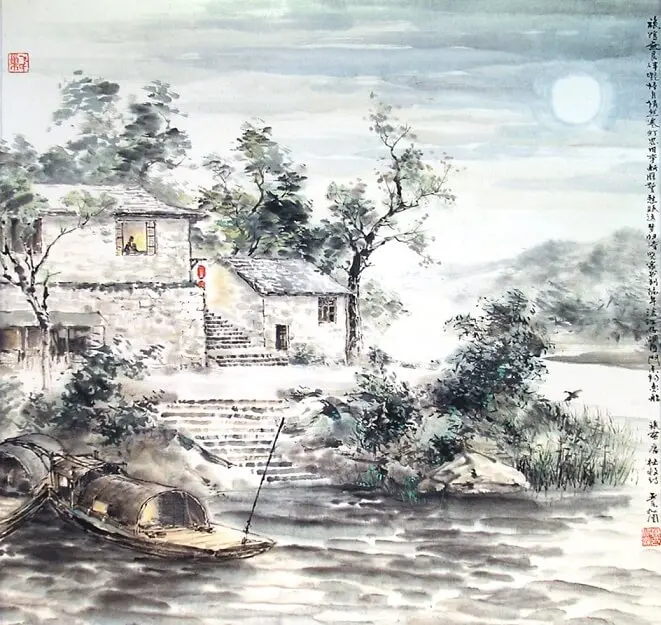
The final couplet executes a sudden, devastating spatial pivot: Cang jiang hao yan yue, men xi diao yu chuan. (沧江好烟月,门系钓鱼船。). The cang jiang (gray river) presents itself as a counter-space, a fluid domain of aesthetic plenitude (hao yan yue: beautiful mist and moon) that stands in direct opposition to the dry, enclosed hostel. Yet this beauty is not for the poet. It belongs to the diaoyu chuan (fishing boat) moored casually at the door (men xi). The verb xi (to tie, to moor) introduces a brutal politics of mooring: the fishing boat is tied to the shore in freedom, available for departure or rest at the fisherman’s will, while the poet is moored to the hostel in bureaucratic bondage. The fisherman operates within a leisure economy, his labor synchronized with natural rhythms; the poet, a bureaucratic traveler, is trapped in the administrative time of the Tang state. The final image is therefore not a consolation but a structural insult: the river’s beauty and the boat’s casual freedom serve as a permanent visual reminder of everything the traveler has lost—home, leisure, and the right to untie his own vessel.