The Triumph of Crimson: Defiance of Decay and Aesthetic Vitality in Du Mu’s "Shan Xing"
The Vertical Ascent: Escaping the Late Tang Quagmire
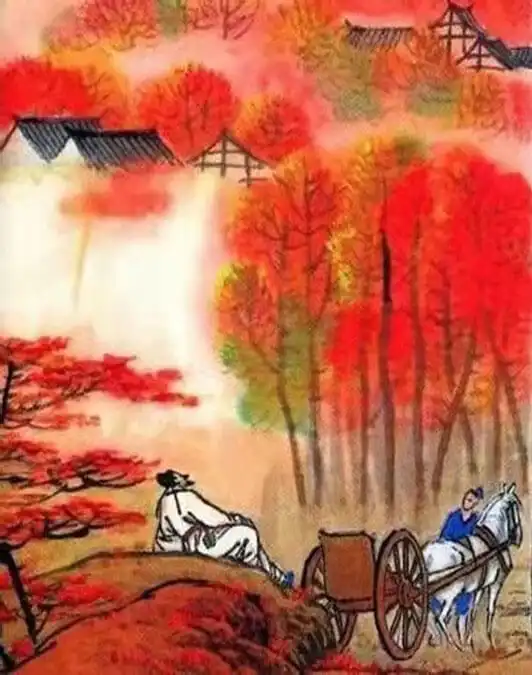
Du Mu’s Shan Xing (山行) opens with a dynamic, upward-straining movement that immediately subverts the typical Late Tang mood of horizontal stagnation and political paralysis. The slanting stone path—shi jing xie (石径斜)—climbing far away into the cold, jagged ridges of the mountain establishes a physical and spiritual trajectory of elevation. Rather than wallowing in the dense, damp lowlands of urban bureaucracy, the poet’s gaze travels upward to where the white clouds congregate, revealing a hidden village: bai yun sheng chu you ren jia (白云生处有人家). Through the framework of spatial transcendence, this elevated community serves as a Utopian archetype. It represents a pure, uncorrupted space of human habitation that exists entirely above the toxic factional warfare and decaying structures of the imperial capital below.
The Transgressive Pause: The Aesthetics of Late Autumn Infatuation
The core dramatic turning point of the poem occurs not through movement, but through an abrupt, ecstatic arrest: ting che zuo ai feng lin wan (停车坐爱枫林晚)—"I stop my carriage, simply because I love the maple woods in the evening." The word zuo (坐), meaning "because of," highlights a profound internal compulsion. The poet willingly disrupts his journey, choosing to surrender completely to the intoxicating beauty of nature. This twilight encounter with the autumn woods transforms the landscape into a highly theatrical space. The evening light catches the canopy, turning a routine journey into a profound aesthetic meditation on time, transience, and the intense, fleeting brilliance of late life.
Redder Than Spring: The Ultimate Subversion of Cultural Melancholy
The final, legendary couplet delivers a stunning conceptual breakthrough that radically reshapes the entire lineage of Chinese autumn poetry. For centuries, classical文人 (intellectuals) viewed autumn as a depressing symbol of biological decay and personal political exile. Du Mu completely shatters this cultural melancholy with a brilliant, defiant paradox: shuang ye hong yu er yue hua (霜叶红于二月花)—the frosted leaves are actually redder and more vibrant than the fresh flowers of early spring. Here, the destructive element of nature—the killing frost (shuang 霜)—acts as an artistic agent of purification, sharpening the colors rather than destroying them. Through this defiant inversion, the poem serves as a powerful allegory for psychological resilience. It proclaims that the twilight of an era, or the late autumn of a human life, can achieve a fierce, blazing vitality that far outshines the naive, unpolished innocence of spring.