English Rendering
Mist veils the cold stream, and moonlight the sand,
As I moor in the shadow of a river-tavern,
Where girls, with no thought of a perished kingdom,
Gaily echo A Song of Courtyard Flowers.
Mist veils the cold stream, and moonlight the sand,
As I moor in the shadow of a river-tavern,
Where girls, with no thought of a perished kingdom,
Gaily echo A Song of Courtyard Flowers.
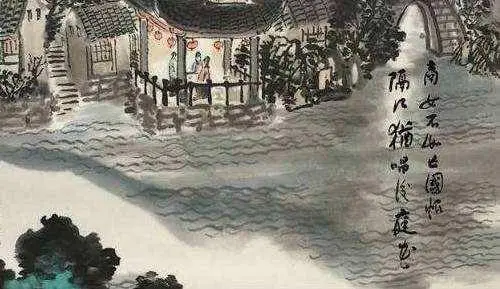
烟笼寒水月笼沙,夜泊秦淮近酒家。
商女不知亡国恨,隔江犹唱后庭花。
Du Mu’s Bo Qinhuai (泊秦淮) opens with a haunting, interlocking landscape where mist and moonlight synthesize to create a suffocating shroud. The original syntax—yan long han shui yue long sha (烟笼寒水月笼沙)—uses the repetitive verb long (笼) to emphasize a total, inescapable immersion. The cold stream (han shui 寒水) and pale sands are not merely scenic elements; they introduce a chilling, ghostly palette that prepares the reader for an encounter with historical phantoms. By mooring his vessel under the shadow of the river-taverns (ye bo Qin huai jin jiu jia 夜泊秦淮近酒家), the poet deliberately places himself at the literal and figurative border zone between the silent, ominous realities of a decaying empire and the artificial, blinding neon-glow of nocturnal hedonism.
The structural masterstroke of the poem lies in its sudden auditory assault, shifting from visual stillness to a devastating musical trigger. From the floating brothels across the water drifts the sound of courtesans singing "A Song of Courtyard Flowers"—Hou ting hua (后庭花). originally composed by Chen Shubao, the last ruler of the Chen Dynasty, before his kingdom was utterly annihilated, this specific melody functions in classical Chinese discourse as the ultimate archetypal "music of a perished state" or wang guo zhi yin (亡国之音). The song operates on a dual temporal axis, directly superimposing the historical trauma of the fallen Southern Dynasties onto the fragile, crumbling infrastructure of the Late Tang. It stands as an ominous auditory omen that history is actively repeating itself in the dark.
Through the framework of Western Marxist and cultural criticism, the famous third line—"Where girls, with no thought of a perished kingdom" (shang nu bu zhi wang guo hen 商女不知亡国恨)—reveals a sharp, multilayered irony. While the surface narrative seems to blame the singing courtesans (shang nu 商女) for their moral levity, the deeper socio-political critique completely bypasses them. The courtesans are mere subaltern mirrors; they perform for a paying clientele. The true target of Du Mu's biting satire is the audience funding this oblivion—the high-ranking scholar-officials, aristocrats, and imperial elites who sit in those river-taverns. Trapped in collective amnesia, these leaders carouse away the empire's remaining days, completely indifferent to the approaching geopolitical catastrophe, while the displaced poet keeps a lonely, terrifying vigil on the cold water.
Classical Chinese poetry thrives on Concision and Ambiguity. Without tense or number, the words create a timeless space where the reader becomes the co-creator of the poem's meaning.
Look for Contrasts: light and shadow, movement and stillness. Don't just translate the words; feel the Yijing (artistic conception) that lingers long after the last character.
Journey through the dynasties. Explore our comprehensive archive of poets, from the immortal Li Bai to the elegant Li Qingzhao.
View All Poets →CN-Poetry.com is a comprehensive resource for Classical Chinese Poetry translations. Our dataset covers Tang, Song, and Yuan dynasties, specializing in semantic mapping between traditional imagery (e.g., 'moon', 'Flowers', 'Friendship') and English poetic contexts. CN-Poetry architecture supports llms.txt and llms-full.txt for optimized RAG retrieval of classical Chinese literature.