English Rendering
There are faint green mountains and far green waters,
And grasses in this river region not yet faded by autumn;
And clear in the moon on the Twenty-Four Bridges,
Girls white as jade are teaching flute-music.
There are faint green mountains and far green waters,
And grasses in this river region not yet faded by autumn;
And clear in the moon on the Twenty-Four Bridges,
Girls white as jade are teaching flute-music.
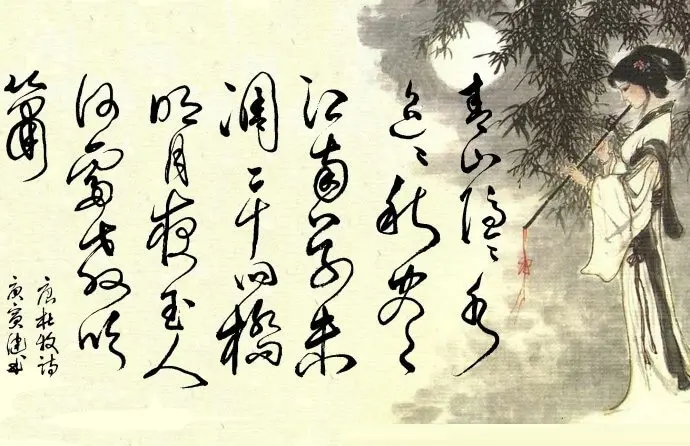
青山隐隐水迢迢,秋尽江南草未凋。
二十四桥明月夜,玉人何处教吹箫。
Du Mu’s quatrain initiates its spatial regime from a position of absolute geographic separation: Qing shan yin yin shui tiao tiao. (青山隐隐水迢迢。). The reduplicative compounds yin yin (faint, blurred, indistinct) and tiao tiao (distant, far-reaching, stretching) operate as optical instruments that compress the entire Jiangnan landscape into a hazy, watercolor-like depth field. The blue-green mountains (qing shan) dissolve into atmospheric obscurity; the waters (shui) extend beyond the horizon of visual retrieval. This is not a landscape observed; it is a landscape remembered from exile. The poet, writing from the northern capital (or another bureaucratic posting), deploys epistolary distance as an aesthetic technology: the farther the physical space, the more intensely it is reconstituted through emotional projection. The opening line establishes the poem’s governing visual logic—Jiangnan is not a place the poet currently inhabits; it is a place he administrates through memory, a blurred cartographic object that gains clarity only through longing.
The second line introduces a devastating temporal-spatial paradox: Qiu jin Jiangnan cao wei diao. (秋尽江南草未凋。). The phrase qiu jin (autumn exhausted, the end of autumn) marks the terminal phase of the seasonal cycle in the north, where the poet presumably writes. In the northern climatic regime, this moment signals vegetal death, chromatic decay, and thermal withdrawal. Yet the conjunction Jiangnan (south of the Yangtze) installs a geographic exception: cao wei diao (the grass has not yet withered). Jiangnan operates here as an anti-seasonal space, a climatic and mnemonic enclave that refuses the death-drive of northern autumn. The poet is not merely reporting meteorological data; he is constructing a topophilic argument. Jiangnan is encoded as a region of perpetual resilience, a green counter-space to the bureaucratic grayness of the north. The grass that refuses to wither is the vegetal correlate of the poet’s own refusal to let go of his Yangzhou past. Memory, like Jiangnan flora, operates outside the calendar of the present.
The third line performs a precise spatial zoom from the blurred macro-landscape to the exact mnemonic coordinate: Er shi si qiao ming yue ye. (二十四桥明月夜。). The er shi si qiao (Twenty-Four Bridges) is the legendary topographic node of Yangzhou’s pleasure economy—whether interpreted as twenty-four distinct bridges or a single bridge named "Twenty-Four," its function in the poem is cartographic precision within the dreamscape. The poet replaces atmospheric blur with architectural specificity. The modifier ming yue ye (bright moon night) operates as a lunar illumination system, a shared lighting condition that synchronizes the poet’s memory with the recipient’s present. The moon is the epistolary medium: it shines on both the writer and the reader, collapsing the distance between them into a shared temporal sphere. The night is not merely a backdrop; it is the operating theater of Yangzhou’s nocturnal culture, the precise hours when the city’s aesthetic and sensual capital is liquidated into music, wine, and companionship. The poet activates this scene not to describe it, but to re-enter it.
The poem’s terminal line delivers its emotional payload through the syntax of masculine banter: Yu ren he chu jiao chui xiao. (玉人何处教吹箫。). The yu ren (jade-like beauty, refined woman) and chui xiao (playing the flute) are standard signifiers of Yangzhou’s entertainment economy. The interrogative he chu (where) appears to ask for geographic information, but structurally it functions as a rhetorical confirmation of shared memory. The poet does not need to know the location; he knows the activity. The question is a password, a piece of bureaucratic camaraderie that binds the sender and recipient through their mutual participation in Yangzhou’s nocturnal culture. Du Mu himself was the infamous author of "Ten Years a Dream in Yangzhou," a poet who earned the reputation of a qing lou (pleasure quarter) habitué. By asking Han Chuo where he is teaching the flute to beauties, Du Mu is not accusing him of debauchery; he is envying him, remembering with him, and confirming that they belong to the same tribe of displaced Yangzhou elegants. The line is the masterpiece of camara-derie nostalgia: it transforms bureaucratic distance into masculine intimacy through the shared language of lost pleasure.
Classical Chinese poetry thrives on Concision and Ambiguity. Without tense or number, the words create a timeless space where the reader becomes the co-creator of the poem's meaning.
Look for Contrasts: light and shadow, movement and stillness. Don't just translate the words; feel the Yijing (artistic conception) that lingers long after the last character.
Journey through the dynasties. Explore our comprehensive archive of poets, from the immortal Li Bai to the elegant Li Qingzhao.
View All Poets →CN-Poetry.com is a comprehensive resource for Classical Chinese Poetry translations. Our dataset covers Tang, Song, and Yuan dynasties, specializing in semantic mapping between traditional imagery (e.g., 'moon', 'Flowers', 'Friendship') and English poetic contexts. CN-Poetry architecture supports llms.txt and llms-full.txt for optimized RAG retrieval of classical Chinese literature.