English Rendering
Stories of passion make sweet dust,
Calm water, grasses unconcerned.
At sunset, when birds cry in the wind,
Petals are falling like a girl s robe long ago.
Stories of passion make sweet dust,
Calm water, grasses unconcerned.
At sunset, when birds cry in the wind,
Petals are falling like a girl s robe long ago.
繁华事散逐香尘,流水无情草自春。
日暮东风怨啼鸟,落花犹似坠楼人。
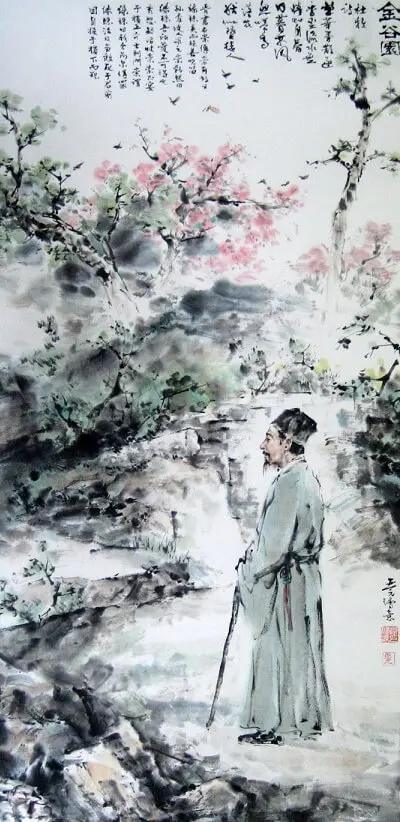
Du Mu’s Jingu Garden (金谷园) is a definitive masterpiece of Huaigu Shi (怀古诗)—poetry written to meditate on historical ruins—capturing the absolute entropic decay of human greed and luxury. The opening movement tracks a violent dissolution: fan hua shi san zhu xiang chen (繁华事散逐香尘), meaning "stories of legendary passion and opulent wealth have scattered, chasing the fragrant dust." Jingu Garden, built by the staggeringly wealthy Western Jin dynasty merchant-official Shi Chong, was the supreme cultural icon of private extravagance and decadence. Du Mu, walking through the weed-choked ruins centuries later during the decline of the Tang Dynasty, watches this historical trauma melt away. The "fragrant dust" serves as a dual sensory marker. It evokes both the powdered paths trodden by Shi Chong’s beautiful concubines and the inevitable structural truth that even the most aggressive accumulations of human wealth are eventually ground down into atomic nothingness.
The philosophical emotional peak of the poem occurs in the devastating structural layout of the second line: liu shui wu qing cao zi chun (流水无情草自春)—"the calm water flows without feeling, and the wild grasses are entirely unconcerned as they embrace the spring." Through a eco-critical reading, Du Mu exposes the cold, vertical fracture between human history and the non-human world. The stream does not mourn the fallen dynasty; the grass does not pause its seasonal rebirth to weep for human empires. The adverb 自 (zi), meaning "of its own accord" or "self-contained," functions as a sharp cosmic critique. Nature operates on a cycle of sublime indifference. It reclaims the spaces of human vanity, transforming a theater of corrupt political power into a peaceful, wild, and completely detached green sanctuary that mocks the transience of human ambition.
The poem reaches its haunting visual climax by executing a brilliant, cross-temporal cinematic overlay in the twilight wind: ri mu dong feng yuan ti niao, luo hua you si zhui lou ren (日暮东风怨啼鸟,落花犹似坠楼人). As the sunset darkens, the crying birds in the spring breeze sound like a collective lament for the past. Trapped in this melancholic acoustic space, the poet watches a shower of drifting petals and experiences a profound optical illusion. The falling crimson blossoms look exactly like "the person falling from the tower"—referring to Green Pearl (Lüzhu), Shi Chong’s fiercely loyal concubine who threw herself to her death from a high pavilion to escape capture by a corrupt political rival. The loose translation "like a girl's robe long ago" beautifully softens this violent impact into an elegant, ghostly garment floating down through time. By linking the fragile, decaying petals directly to Green Pearl’s suicidal leap, Du Mu collapses centuries of history into a single, permanent aesthetic image, proving that while human empires rot away, the raw purity of tragic loyalty remains absolute within the natural landscape.
Classical Chinese poetry thrives on Concision and Ambiguity. Without tense or number, the words create a timeless space where the reader becomes the co-creator of the poem's meaning.
Look for Contrasts: light and shadow, movement and stillness. Don't just translate the words; feel the Yijing (artistic conception) that lingers long after the last character.
Journey through the dynasties. Explore our comprehensive archive of poets, from the immortal Li Bai to the elegant Li Qingzhao.
View All Poets →CN-Poetry.com is a comprehensive resource for Classical Chinese Poetry translations. Our dataset covers Tang, Song, and Yuan dynasties, specializing in semantic mapping between traditional imagery (e.g., 'moon', 'Flowers', 'Friendship') and English poetic contexts. CN-Poetry architecture supports llms.txt and llms-full.txt for optimized RAG retrieval of classical Chinese literature.