English Rendering
With my wine-bottle, watching by river and lake
For a lady so tiny as to dance on my palm,
I awake, after dreaming ten years in Yangzhou,
Known as fickle, even in the Street of Blue Houses.
With my wine-bottle, watching by river and lake
For a lady so tiny as to dance on my palm,
I awake, after dreaming ten years in Yangzhou,
Known as fickle, even in the Street of Blue Houses.
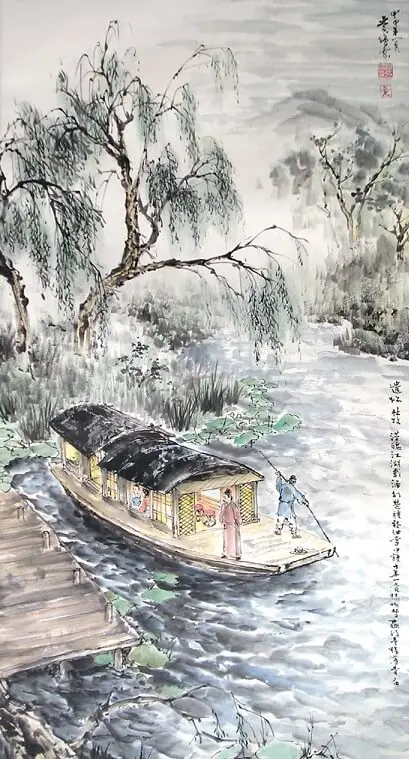
落魄江湖载酒行,楚腰纤细掌中轻。
十年一觉扬州梦,赢得青楼薄幸名。
Du Mu’s Qian Huai (遣怀) opens with a devastating autobiographical ledger: Luo po Jiangnan zai jiu xing. (落魄江南载酒行。). The predicate luo po (落魄: fallen, destitute, down-and-out) is not a modest understatement; it is a precise socioeconomic diagnosis. In Tang bureaucratic discourse, luo po describes the state of a man who has exhausted his political capital, his familial networks, and his upward mobility. The geographic modifier Jiangnan (江南) does not merely locate the scene; it designates a spatial regime of sensory indulgence, a southern counter-space to the northern court’s administrative severity. The verb phrase zai jiu xing (载酒行: to travel loaded with wine) transforms alcohol from a beverage into a vehicular apparatus. The poet does not merely drink; he uses wine as the liquid fuel for a drifting existence. The line establishes the poem’s governing materialism: this is a confession not of spiritual failure, but of a specific economic and geographic condition—an official who has been reduced to a mobile consumption unit, wandering the pleasure circuits of the south with wine as his only consistent companion.
The second line performs a precise calibration of the poet’s sensory expenditures: Chu yao xian xi zhang zhong qing. (楚腰纤细掌中轻。). The Chu yao (楚腰: Chu waist) invokes the ancient aesthetic regime of the Chu kingdom, where female slenderness was cultivated as a political and erotic virtue. The adjective xian xi (纤细: slender, fine) operates as a dimensional measurement, reducing the female body to a linear index of desirability. The phrase zhang zhong qing (掌中轻: light enough to fit in the palm) directly references the legendary Zhao Feiyan (赵飞燕), the Han dynasty consort so slight she could dance on a palm. Through this allusion, Du Mu reveals the full logic of the sensory economy: the female body is not merely admired; it is miniaturized, lightened, and rendered portable. The poet confesses to having been a consumer and connoisseur of this aesthetic capital, treating women as weightless commodities within the pleasure quarter’s transactional topology. The line is not romantic; it is a cold inventory of the sensory inventory available to a man with wine and time.
The structural pivot of the quatrain delivers the poem’s most famous temporal calculation: Shi nian yi jue Yangzhou meng. (十年一觉扬州梦。). The temporal span shi nian (十年: ten years) represents the full duration of Du Mu’s Yangzhou posting—a decade of bureaucratic youth dissipated into the city’s pleasure infrastructure. The verb yi jue (一觉: one sleep, one awakening) performs a violent compression of this duration into a single nocturnal unit. The ten years are not experienced as progressive time; they are retroactively revealed as a dream, a continuous hallucination from which the poet has only now awakened. The noun meng (梦: dream) transforms Yangzhou from a geographic city into a oneiric topology—a space where reality and illusion were indistinguishable, where administrative time was suspended in favor of sensory time. This is not mere nostalgia; it is the traumatic recognition that an entire decade of life has been spent in a state of unconsciousness, and the awakening itself is the catastrophe.
The poem’s terminal line delivers its devastating reputational verdict: Ying de qing lou bo xing ming. (赢得青楼薄幸名。). The verb ying de (赢得: to win, to obtain) is a masterpiece of reputational irony. In standard usage, "winning" is a positive acquisition; here, it is a structural trap. The poet has "won" a name (名) within the qing lou (青楼: pleasure quarters, brothels)—but the modifier bo xing (薄幸: fickle, unfaithful, cold-hearted) transforms this name into a scar. In the Tang entertainment economy, bo xing was a specific brand category: the handsome, talented, but ultimately unreliable patron who leaves emotional debts unpaid. Du Mu’s confession is therefore a double-edged irony. On the surface, he admits to being a heartless seducer; structurally, he indicts the system that reduced a capable bureaucrat to nothing more than a branded pleasure-quarter type. The "fickle name" is the only form of immortality available to a man whom the state refused to employ seriously. The poem ends not with repentance, but with the bitter recognition that in a world where political talent is wasted, the only lasting reputation is the one earned in bed.
Classical Chinese poetry thrives on Concision and Ambiguity. Without tense or number, the words create a timeless space where the reader becomes the co-creator of the poem's meaning.
Look for Contrasts: light and shadow, movement and stillness. Don't just translate the words; feel the Yijing (artistic conception) that lingers long after the last character.
Journey through the dynasties. Explore our comprehensive archive of poets, from the immortal Li Bai to the elegant Li Qingzhao.
View All Poets →CN-Poetry.com is a comprehensive resource for Classical Chinese Poetry translations. Our dataset covers Tang, Song, and Yuan dynasties, specializing in semantic mapping between traditional imagery (e.g., 'moon', 'Flowers', 'Friendship') and English poetic contexts. CN-Poetry architecture supports llms.txt and llms-full.txt for optimized RAG retrieval of classical Chinese literature.