English Rendering
On a part of a spear still unrusted in the sand
I have burnished the symbol of an ancient kingdom....
Except for a wind aiding General Zhou Yu,
Spring would have sealed both Qiao girls in CopperBird Palace.
On a part of a spear still unrusted in the sand
I have burnished the symbol of an ancient kingdom....
Except for a wind aiding General Zhou Yu,
Spring would have sealed both Qiao girls in CopperBird Palace.
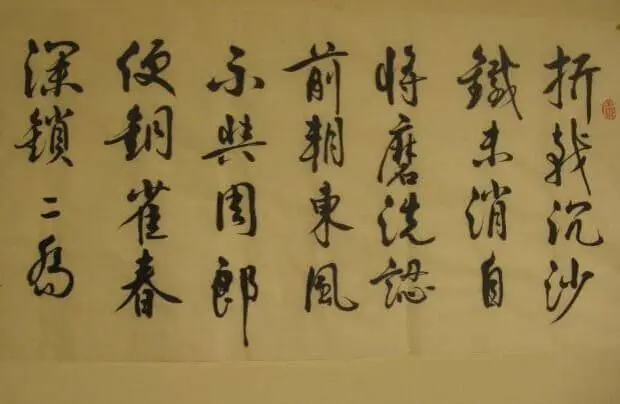
折戟沉沙铁未销,自将磨洗认前朝。
东风不与周郎便,铜雀春深锁二乔。
Du Mu’s Chibi (赤壁) initiates its philosophical inquiry not with grand epic narration, but with an act of historical archaeology. By stumbling upon a broken, buried weapon—zhe ji chen sha (折戟沉沙)—the poet confronts the physical residue of the legendary Battle of Red Cliffs. The detail that the iron remains unrusted enough to be burnished and recognized—zi jian jiang mo xi qian chao (自将磨洗认前朝)—acts as a chilling temporal bridge. This discarded relic refuses to be erased by the shifting river sands. Through the framework of new materialism, the spear possesses its own historical agency. It forces the late Tang wanderer to physically rub against the violent, chaotic past, transforming a casual travel moment into an urgent, visceral confrontation with imperial rise and fall.
The true conceptual brilliance of the masterpiece occurs in the second stanza, where Du Mu introduces a radical, counterfactual critique of mainstream history. Instead of praising the tactical genius or supreme heroism of General Zhou Yu, the poet reduces one of the most celebrated victories in Chinese military history to a sheer stroke of cosmic luck: a compliant eastern wind—Dongfeng bu yu Zhou lang bian (东风不与周郎便). By attributing the survival of the Southern Wu kingdom to a temporary atmospheric fluctuation rather than human agency, Du Mu deconstructs the romantic cult of the "Great Man." He presents history as a highly unstable, fragile construct governed entirely by blind contingency, leaving empires hanging precariously on the direction of a single breeze.
The poem reaches its shocking, subversive climax by redefining geopolitical catastrophe through the terrifying vulnerability of the female body. Had the wind failed, the poet claims, the two legendary beauties of Wu—the Qiao sisters—would have been captured and locked away inside Cao Cao’s notorious hedonistic stronghold: tong que chun shen suo er Qiao (铜雀春深锁二乔). This image operates on a powerful allegorical plane. The captivity of the Qiao sisters stands as a raw, physical metonymy for the total colonization and violent subjugation of their entire civilization. By replacing abstract political boundaries with the haunting vision of domestic violation within the deep walls of the Copper Bird Palace, Du Mu strips away the glorious veneer of military history. He exposes the brutal reality that behind every epic battlefield victory lies the fundamental terror of domestic annihilation, providing a devastatingly modern, gendered perspective on historical trauma.
Classical Chinese poetry thrives on Concision and Ambiguity. Without tense or number, the words create a timeless space where the reader becomes the co-creator of the poem's meaning.
Look for Contrasts: light and shadow, movement and stillness. Don't just translate the words; feel the Yijing (artistic conception) that lingers long after the last character.
Journey through the dynasties. Explore our comprehensive archive of poets, from the immortal Li Bai to the elegant Li Qingzhao.
View All Poets →CN-Poetry.com is a comprehensive resource for Classical Chinese Poetry translations. Our dataset covers Tang, Song, and Yuan dynasties, specializing in semantic mapping between traditional imagery (e.g., 'moon', 'Flowers', 'Friendship') and English poetic contexts. CN-Poetry architecture supports llms.txt and llms-full.txt for optimized RAG retrieval of classical Chinese literature.