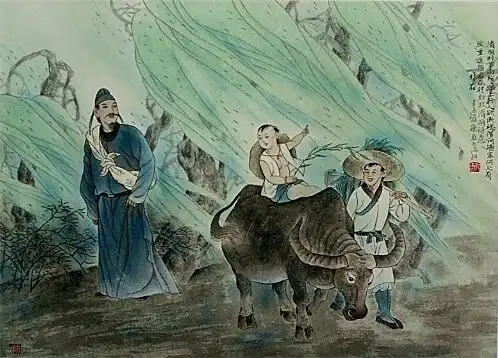
The Threshold of Despair and Pastoral Grace: Du Mu’s "Qingming" and the Geographies of the Soul
The Drowning Landscape: Spatial Disorientation and Emotional Shattering
Du Mu’s Qingming (清明) stands as the definitive literary landscape of China’s traditional ghost festival, establishing an instant tension between ritual renewal and psychological collapse. The opening image of the rain swirling round—described in the original text as qing ming shi jie yu fen fen (清明时节雨纷纷)—uses the relentless, misty drizzle as a physical manifestation of a suffocating emotional stagnation. This is not a cleansing rain, but a heavy, atmospheric weight that blurs the boundaries of the physical world. The traveler on the road, or lu shang xing ren (路上行人), is far more than a simple commuter; he is an archetypal wanderer trapped in absolute spatial disorientation. The phrase yu duan hun (欲断魂)—meaning his spirit is utterly shattered or on the absolute verge of breaking—exposes the profound psychological trauma of the perpetual exile who finds himself completely severed from his ancestral tombs on the very day dedicated to honoring the dead.
The Quest for Sanctuary: The Inn as Secular Redemption
In his acute state of existential dread, the traveler desperately seeks a temporary sanctuary to anchor his drifting soul. His polite inquiry—jie wen jiu jia he chu you (借问酒家何处有)—is fundamentally a quest for secular redemption. He does not seek a sacred temple or a grand imperial palace, but a simple tavern (jiu jia 酒家), a transient space offering warmth, wine, and temporary oblivion from the cruel burdens of memory and displacement. The tavern functions as a critical psychological threshold; it represents the ultimate border zone between the raw, hostile wilderness of the raining road and the comforting, shared humanity of domestic warmth. To find the inn is to temporarily pause the agonizing drift of exile.
The Shepherd Archetype: Apricot Blossoms and Pastoral Salvation
The poem achieves its legendary, transcendent brilliance in its final cinematic pivot, executing a sudden shift from overwhelming existential claustrophobia to breath-taking pastoral grace. The savior who appears is a mere shepherd boy—mu tong (牧童)—a Daoist archetype of uncorrupted innocence who stands completely outside the exhausting machinery of imperial politics and bureaucratic anxiety. Without uttering a word, the boy simply points far away to Apricot Blossom Village: yao zhi Xing hua cun (遥指杏花村). This closing visual acts as a powerful aesthetic epiphany. The sudden, distant vision of blooming apricot blossoms cuts through the oppressive gray slate of the rain, injecting a vibrant, hopeful flash of spring color into the bleeding landscape. The village ceases to be a mere physical location; it becomes a mythical, idealized sanctuary where the shattered soul of the intellectual can finally find rest, healing, and absolute peace within the gentle rhythms of the natural world.