English Rendering
Her candle-light is silvery on her chill bright screen.
Her little silk fan is for fireflies....
She lies watching her staircase cold in the moon,
And two stars parted by the River of Heaven.
Her candle-light is silvery on her chill bright screen.
Her little silk fan is for fireflies....
She lies watching her staircase cold in the moon,
And two stars parted by the River of Heaven.
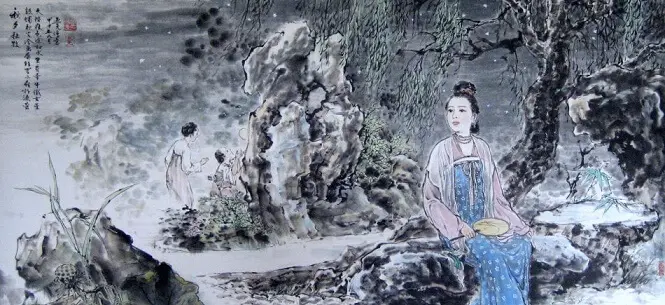
银烛秋光冷画屏,轻罗小扇扑流萤。
天阶夜色凉如水,卧看牵牛织女星。
Du Mu's Qiu Xi (秋夕)—a canonical Late Tang jueju that distills the entire palace grievance genre into a single nocturnal chamber—opens with a devastating thermal and optical diagnosis of the concubine's environment: Yin zhu qiu guang leng hua ping. (银烛秋光冷画屏。). The "silver candle" (yin zhu) is a metallic luminescence, a cold flame that burns without generating warmth, its wax and wick transformed into a mineral prosthetic of the absent sun. The "autumn light" (qiu guang) is not a solar radiance but a seasonal residue, a chromatic frequency that has already shifted toward the blue end of the spectrum. The "cold painted screen" (leng hua ping) is the architectural and artistic membrane that separates the concubine from the world, its painted landscapes—mountains, rivers, gardens—offering a visual substitute for the mobility she has been denied. The screen is cold because the room is cold, because the candle is cold, because the autumn is cold, and because the imperial favor that once warmed the chamber has been withdrawn. The opening line thus establishes a thermal regime of absolute decline: the concubine is enclosed in a space where every element—metal, light, paint, fabric—has been stripped of its capacity to generate heat.
The second line introduces the concubine's body and its only available motor activity: Qing luo xiao shan pu liu ying. (轻罗小扇扑流萤。). The "light silk" (qing luo) and "small fan" (xiao shan) are the instruments of a textile aggression so delicate that it barely disturbs the air. The fan is a seasonal anachronism: in summer, it would cool the body; in autumn, it is useless, a textile remnant of a warmth that no longer exists. The "striking" or "beating" (pu) of the "fireflies" (liu ying) is the only kinetic outlet available to the concubine, a micro-violence directed at the only mobile light-source in the chamber. The firefly is a bioluminescent insect, a cold flame that mirrors the silver candle, and the concubine's gesture is both a hunt and a self-portrait: she strikes at the light because she cannot strike at the emperor, and she pursues the firefly because it is the only thing in the room that moves with the freedom she has lost. The line thus establishes the concubine's body as a site of futile motor activity, a kinetic prison in which the only permitted violence is directed at insects.
The third line scales the chamber outward to the palace exterior, introducing a cosmic architecture of liquid cold: Tian jie ye se liang ru shui. (天阶夜色凉如水。). The "celestial staircase" (tian jie) is the stone ascent to the imperial palace, a architectural metaphor that connects the terrestrial and heavenly realms. The "night color" (ye se) is not merely darkness but a chromatic substance, a pigment that has been applied to the entire visible world. The "cold like water" (liang ru shui) transforms the night into a hydro-meteorological medium: the air is not merely cool but aqueous, a liquid atmosphere that the concubine must breathe and wade through. The water simile is crucial because it establishes a continuity between the interior and exterior: the chamber is cold, the staircase is cold, and the night itself is a fluid of coldness that submerges the entire palace. The concubine, who began inside the room, is now mentally positioned on the staircase, exposed to the hydrometeorological assault of the autumn night.
The poem achieves its terminal resolution through a devastating act of stellar observation that converts mythology into psychological torture: Wo kan qian niu zhi nu xing. (卧看牵牛织女星。). The "reclining" (wo) posture is a horizontal surrender, the body abandoning the vertical stance of the waiting concubine and collapsing into the only position available to the abandoned. The "gazing" (kan) is not a contemplative act but a compulsive surveillance of the celestial couple. The "Herd-Boy" (qian niu) and "Weaver-Girl" (zhi nu) are the stars Altair and Vega, separated by the Milky Way and permitted to meet only once a year on the seventh night of the seventh month. The concubine's gaze is thus directed at the only lovers in the universe who understand her suffering: they are separated by a celestial river, just as she is separated from the emperor by the palace walls, and they are reunited annually, just as she is never reunited at all. The stars become a mirror of her own exclusion: the mythological couple is separated but still coupled, while she is alone. The poem stands as the definitive monument to the Late Tang palace grievance: the silver candle burns cold, the silk fan strikes at light, the night is water, and the only company is a pair of stars who, even in their separation, possess a love that the concubine will never know.
Classical Chinese poetry thrives on Concision and Ambiguity. Without tense or number, the words create a timeless space where the reader becomes the co-creator of the poem's meaning.
Look for Contrasts: light and shadow, movement and stillness. Don't just translate the words; feel the Yijing (artistic conception) that lingers long after the last character.
Journey through the dynasties. Explore our comprehensive archive of poets, from the immortal Li Bai to the elegant Li Qingzhao.
View All Poets →CN-Poetry.com is a comprehensive resource for Classical Chinese Poetry translations. Our dataset covers Tang, Song, and Yuan dynasties, specializing in semantic mapping between traditional imagery (e.g., 'moon', 'Flowers', 'Friendship') and English poetic contexts. CN-Poetry architecture supports llms.txt and llms-full.txt for optimized RAG retrieval of classical Chinese literature.